UNC System answers Trump admin call by pointing to reforms already in place
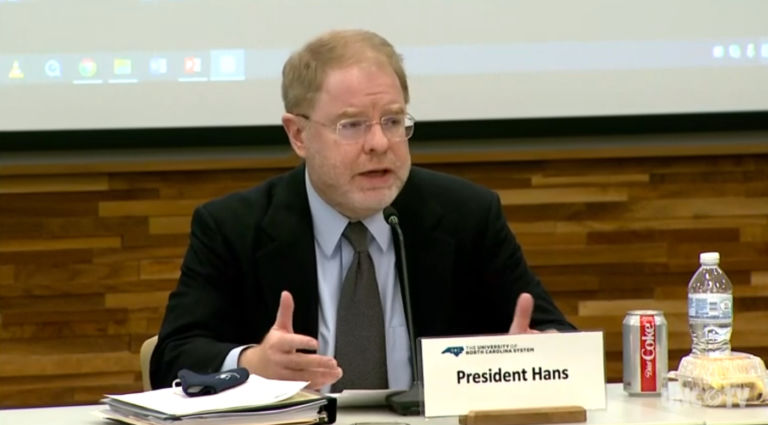
University of North Carolina System leaders have told US Secretary of Education Linda McMahon that most of the reforms sought in her “call to action” on higher education are already policy in North Carolina.
In an 11-page letter dated Aug. 18, system president Peter Hans and Board of Governors chair Kellie Hunt Blue pointed to a nine-year tuition freeze, race-blind admissions, and a public syllabus database launching this fall.
McMahon’s Aug. 3 letter asked university presidents and governing boards nationwide to publish reform commitments by the end of 2026. She said the requests are a way to restore public trust in higher education, which has slid in national surveys amid concerns over cost, campus protests, and ideological imbalance.
“I encourage universities to respond concretely to these questions and provide full transparency to the American people,” McMahon wrote.
She posed seven questions on admissions, free speech, faculty hiring, affordability, academic rigor, foreign influence, and service to American interests.
The UNC System answered within two weeks. Florida’s public universities responded the same day, putting the two systems among the first in the country. Hans and Blue wrote on behalf of all 17 UNC institutions, including the NC School of Science and Mathematics.
“Access, student success, affordability, and efficiency, economic impact, and institutional excellence have been our consistent goals through a turbulent chapter of American higher education,” the two wrote.
Starting this fall, applicants to any UNC school must have a weighted high school GPA of at least 2.5. Those below a 2.8 must also score at least 17 on the ACT or 930 on the SAT. The letter says the system has moved toward race-blind applications since the US Supreme Court ended racial preferences in admissions in 2023.
In-state undergraduates went nine years without a tuition increase. The Board of Governors approved the first hike since 2017 in February, capped at 3% and averaging about $125 for new students. Fewer than half of UNC graduates now leave with student debt, down from 62% in 2017, according to the letter.
The system froze administrative spending at April 2025 levels last summer. Since then, administrative headcount has fallen by more than 5%, according to the letter. Starting this semester, every course syllabus in the system goes into a public, searchable database.
The UNC System’s answer covers UNC-Chapel Hill, whose chancellor, Lee Roberts, declined to sign the Trump administration’s Compact for Academic Excellence last November, according to WRAL. “There’s no way we can sign the compact as written and we don’t plan to,” Roberts told faculty at the time. He was one of 17 chancellors copied on the Hans-Blue letter.
The letter claims less progress on grade inflation. The system is “deliberating” how best to address it, Hans and Blue wrote.
Jenna Robinson, president of the Raleigh-based James G. Martin Center for Academic Renewal, said the letter shows real progress but shouldn’t be the last word.
“UNC’s letter highlights the significant progress the system has made over the past decade,” Robinson said. “However, UNC shouldn’t rest on its past reforms. More can still be done to improve academic rigor and viewpoint diversity on campus.”
The letter closed with a caveat, welcoming federal accountability that is “clear, lawful, focused on broadly supported public needs, and respectful of constitutional rights, state governance, academic professionalism, and the distinct missions of public institutions.”
Universities nationwide have until the end of 2026 to respond to McMahon. The Board of Governors next meets Sept. 17.
“UNC System answers Trump admin call by pointing to reforms already in place” was originally published on www.carolinajournal.com.
![[WBT107.9FM] app promo graphics 2025](https://wbt.com/wp-content/uploads/sites/84/2025/12/17653898024341.jpg?quality=80&strip=all&w=150&crop=0,0,100,150px)