Heat pushes NC apple harvest earlier
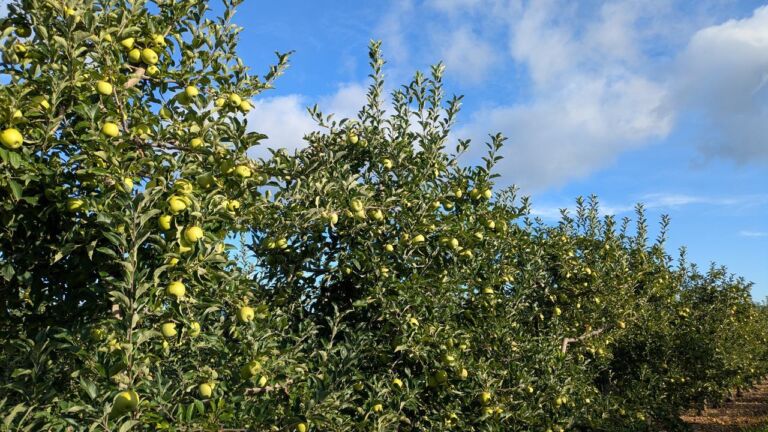
Apple growers in western North Carolina are navigating an unusually fast harvest season as heat, humidity and rainfall accelerate fruit maturity and complicate decisions about when to pick.
Fruit maturity for some cultivars is running seven to 14 days earlier than normal, according to an Aug. 18 update from an apple maturity monitoring program conducted by NC State University researchers in cooperation with the Henderson County Master Pomology Program.
“Keeping pace with harvest this season has been a challenge for many,” researchers said in the latest report.
The program was established in 1986 to provide commercial growers with weekly information on fruit maturity in several apple cultivars. Researchers sample fruit in commercial orchards in Henderson County and report measurements including firmness, soluble solids, starch pattern, fruit weight, diameter and marketable blush.
The information is intended to assist growers with harvest-management decisions, but researchers stress that the results apply only to the orchard blocks being sampled.
“Do not assume that fruit at your location is at the same stage of maturity,” the report said. “To be clear, there is no substitute for regular monitoring of fruit quality parameters at your own operation.”
Weather compresses harvest window
The latest report points to weather as a major factor in the accelerated maturity.
From Aug. 14 through Aug. 20, temperatures in Mills River were approximately 4 degrees Fahrenheit above the 38-year average. The area received 1.36 inches of precipitation, near the historical average, while relative humidity was 7.5% higher than average.
“Accelerated fruit maturity, excessive heat, high humidity, and frequent rainfall has complicated harvest activities,” the report said.
The effects are showing up differently among cultivars. Researchers reported rapid reductions in firmness in some apples and poor development of red fruit color.
A shift toward cooler temperatures and drier air was expected during the first half of the following week, potentially providing better conditions for harvest and fruit color development.
The weather is particularly important because harvest timing depends on more than appearance. Growers consider the intended market and several measures of fruit maturity when determining when to pick.
Honeycrisp faces color, cracking concerns
Honeycrisp presents a more complicated harvest picture.
The sampled Royal Red Honeycrisp fruit had 15.3 pounds of firmness, 14.5% soluble solids and a starch pattern index of 5.1 on Aug. 18. Researchers said those measurements placed the remaining fruit “on the threshold of being harvested.”
“Marketable blush remains low at 3% and may be difficult to achieve this season,” researchers said in the report.
Skin cracking also has been observed across many Honeycrisp blocks.
The Aug. 18 sample was based on apples remaining on the trees after fruit had been spot-picked the previous week.
Red Delicious reaches storage stage
Red Delicious also appeared ready for long-term storage based on the sampled fruit. On Aug. 18, the apples averaged 14.9 pounds of firmness, 9.5% soluble solids and a starch pattern index of 3.5. Marketable blush fell from 67% on Aug. 11 to 49% on Aug. 18.
Researchers said the decline was likely an artifact of the sampling procedure.
Red Delicious also has shown signs of earlier-than-usual development. On Aug. 4, researchers noted that they were sampling the cultivar about a month earlier than its “normal” harvest period but were already seeing signs of starch degradation and lower-than-expected firmness.
Granny Smith remains immature
Granny Smith was evaluated for the first time Aug. 18 and remained immature at that sampling interval.
The sampled fruit averaged 18.4 pounds of firmness, 10.1% soluble solids and a starch pattern index of 1.7. Average fruit weight was 176 grams, with a diameter of 2.92 inches.
The results underscore why researchers are cautioning growers against treating regional maturity data as a universal harvest schedule.
Different cultivars can be at substantially different stages of development at the same time, even within the same general growing region.
A broader effort to help growers
The maturity-monitoring program continues an effort begun in Henderson County to give growers more timely information about harvest conditions.
The 2026 program was planned to evaluate multiple cultivars, with sampling beginning several weeks before anticipated harvest and continuing weekly until commercial harvest. Researchers have said they hope the effort can eventually expand to additional major apple-producing areas in North Carolina, South Carolina, and Georgia.
The project is being conducted with cooperation from Grandad’s Apples, which is providing access to its orchard and fruit for sampling.
Researchers credited technician Tatiana Zuber and the Henderson County Master Pomology Program, whose volunteers helped inspire the pilot project and are assisting with data collection.
The research also fits into a broader effort at NC State to address the economic challenges facing apple growers.
Tom Kon, an associate professor of horticultural science and apple specialist at NC State’s Mountain Horticultural Crops Research and Extension Center in Mills River, described crop-load management as one of the most consequential annual decisions growers make.
“Crop load management is the intentional removal of flower buds, flowers, and/or immature fruit and is arguably one of the most important annual management decisions for apple growers,” Kon told WNC Business.
“In most years, apple trees produce an excessive number of fruit, and over 70 percent must be removed, or ‘thinned,’ to optimize crop value, enhance fruit quality, and ensure consistent cropping.” Kon has also warned that the financial consequences can extend beyond a single harvest. “One bad decision or outcome can reduce orchard profitability for multiple years,” he said.
Researchers are separately investigating technologies that could eventually give growers more information about fruit and buds without damaging them, including radio-frequency imaging and artificial intelligence.
“Heat pushes NC apple harvest earlier” was originally published on www.carolinajournal.com.
![[WBT107.9FM] app promo graphics 2025](https://wbt.com/wp-content/uploads/sites/84/2025/12/17653898024341.jpg?quality=80&strip=all&w=150&crop=0,0,100,150px)