Bayard v. Singleton: Judicial review’s NC origins

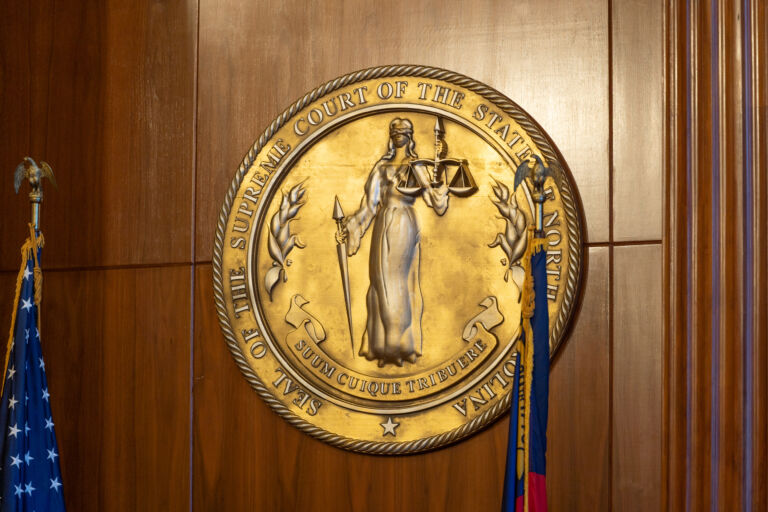
Judicial review is the authority of courts to declare government actions unconstitutional — a power, surprisingly enough, not expressly written into the Constitution. Most Americans learn that judicial review began with Marbury v. Madison in 1803, when the United States Supreme Court asserted its authority to invalidate unconstitutional laws. Yet sixteen years earlier, North Carolina’s courts had already exercised that power in Bayard v. Singleton — case that may represent the earliest surviving reported American judicial decision in which a court expressly declared a legislative act unconstitutional and refused to enforce it.
Case Details:
The case began with Samuel Cornell, a member of the North Carolina’s Royal Governor’s Council and owner of a valuable waterfront property in New Bern. In 1775, as the American Revolution was beginning, Cornell returned to England.
In 1777, Cornell returned to New Bern. Upon his arrival, he refused to swear allegiance to North Carolina’s new revolutionary government. As a result, state authorities denied him the rights and protections afforded to citizens and barred him from remaining in the state. Hoping to prevent confiscation of his property, Cornell transferred the New Bern property to his daughter, Elizabeth Cornell Bayard.
In 1779, North Carolina seized the property under its wartime confiscation laws. Five years later in 1784, the state sold the property to patriot Spyers Singleton, who received title directly from the state’s Commissioner of Confiscated Estates.
In 1785, the North Carolina legislature enacted legislation that barred former loyalists and their heirs from filing lawsuits to recover confiscated property. In doing so, the law deprived claimants of their constitutional right to a jury trial in disputes involving their property.
Despite the statute, Elizabeth Cornell Bayard, a citizen of North Carolina, filed suit to reclaim the New Bern property.
Elizabeth Bayard was represented by Samuel Johnston and William R. Davie, both of whom would later serve as governors of North Carolina. Spyers Singleton was represented by former governor Abner Nash and Alfred Moore— he would later become an associate justice of the United States Supreme Court. The case was heard in the Superior Court of North Carolina in New Bern. At the time, the Superior Court served as the highest judicial authority in the state, with panels of three judges traveling throughout the state to hear complex cases. In this case, the three-judge circuit consisted of Samuel Ashe, Samuel Spencer, and John Williams.
Relying on the Confiscation Acts, Singleton moved to dismiss the suit on the grounds that he held lawful title to the property through a deed issued by the state of North Carolina.
Before issuing its ruling, the court made “every reasonable endeavor” to avoid a confrontation with the legislature, including encouraging the parties to settle and giving the legislature an opportunity to repeal the law. Despite these efforts, the court concluded that the Confiscation Acts were unconstitutional, allowing the suit for recovery of the property to proceed before a jury.
As the judges explained, “the constitution… standing in full force as the fundamental law of the land, notwithstanding the act on which the present motion was grounded, the same act must of course, in that instance, stand as abrogated and without any effect.”
The court held that the Confiscation Acts were in direct violation of Article I, Section 14 (now Section 25) of the North Carolina Constitution, which guaranteed the right to a jury trial in disputes involving property. As the court wrote, “That by the constitution every citizen had undoubtedly a right to a decision of his property by a trial by Jury.”
At trial, the court concluded that Samuel Cornell was to be treated as an alien of the state with respect to the property, which had been owned prior to North Carolina’s independence. As a result, he lacked the legal capacity to hold valid title, and the subsequent transfer to Elizabeth Cornell Bayard was ineffective.

Historical Significance
The North Carolina decision in Bayard v. Singleton supports a strong argument that it represents the earliest state court case to clearly exercise judicial review. In my view, it is the first fully documented American judicial decision to expressly invalidate a legislative act on constitutional grounds.
Earlier cases are sometimes cited as precedents for judicial review, but they are either not fully preserved in written form or do not clearly articulate the principle in an explicit judicial opinion. As a result, they do not provide the same clear, documentary foundation as the North Carolina decision.
Holmes v. Walton (1780) was a New Jersey case in which the state court is reported to have invalidated a wartime trade statute permitting six-person juries instead of the constitutionally required 12. However, no official written opinion survives, and the court’s reasoning is pieced together only through later accounts and secondary references. As a result, it remains unclear whether the decision explicitly asserted the power of judicial review or whether the judges simply treated the statute as inconsistent with existing procedural requirements governing jury trials.
In Trevett v. Weeden (1786), Rhode Island’s highest court was involved in a dispute concerning a statute that penalized refusal to accept depreciated paper currency and limited the availability of jury trials. The case is often cited in discussions of early judicial resistance to unconstitutional legislation. However, it is an imperfect precedent for judicial review because the court avoided a direct constitutional showdown, officially dismissing the case for lack of jurisdiction rather than explicitly striking down the statute.
Bayard v. Singleton remains one of the most significant yet underrecognized constitutional decisions in early American legal history. Long before Marbury v. Madison formalized judicial review at the federal level, North Carolina’s judiciary confronted the fundamental question of whether a legislature could override constitutional guarantees. In doing so, the court articulated a principle that is central to the American judicial system.
This principle closely reflects the reasoning later advocated by Alexander Hamilton in Federalist No. 78, where he argued that courts must treat the Constitution as the supreme law and refuse to enforce statutes that conflict with it. Although judicial review is not explicitly outlined in the Constitution’s text, this power gives the judiciary a necessary check on the legislative branch, consistent with the system of separated powers envisioned by the Founding Fathers.
“Bayard v. Singleton: Judicial review’s NC origins” was originally published on www.carolinajournal.com.