Judges reject 2023 redistricting lawsuits, no congressional map ruling
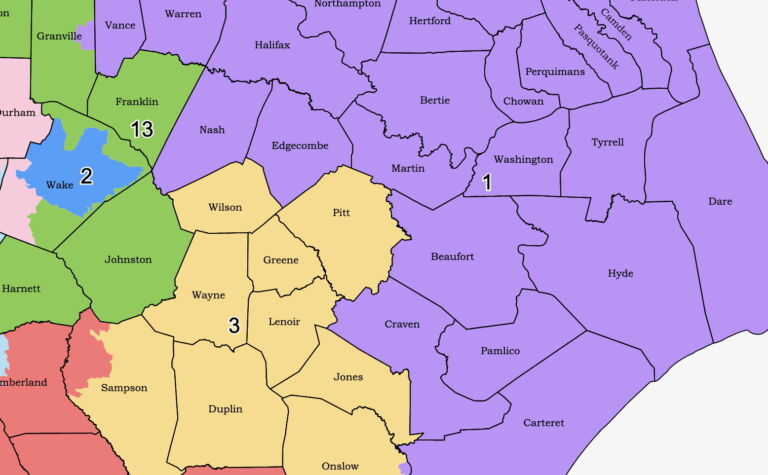
A three-judge panel has dismissed most of the claims in two federal lawsuits brought against election maps used for North Carolina’s congressional and legislative contests in 2024. The panel has made no decision about objections the plaintiffs raised about the state’s new congressional map.
US Appeals Court Judge Allison Jones Rushing and US District Judges Richard Myers and Thomas Schroeder issued their 181-page decision Thursday, one day after hearing arguments for and against the new congressional map.
Republican presidents appointed all three judges. Two of the judges owe their participation in the case to Chief Judge Albert Diaz of the 4th US Circuit Court of Appeals, an appointee of former Democratic President Barack Obama.
The panel conducted a six-day trial this summer on challenges to maps drawn in 2023. Two sets of plaintiffs challenged the previous congressional map and maps for state House and Senate races. The lawsuits claimed that the maps violated constitutional restrictions against vote dilution and racial gerrymandering.
“Having considered the entire record, judged the credibility of each witness, and weighed all the evidence, the Court finds that Plaintiffs have failed to prove any of their claims against Defendants regarding the 2023 redistricting,” the judges wrote.
The order leaves open the two lawsuits’ complaints about changes in Congressional Districts 1 and 3 that were tied to Senate Bill 249, approved last month. Republican legislative leaders argued that they made the changes to give GOP candidates a better chance to win District 1, now held by Rep. Don Davis, a Democrat.
“[T]he Court finds no just reason for delay in the entry of final judgment on all claims except those related to S.B. 249 and the new CD 1 and CD 3,” the panel wrote.
The North Carolina State Conference of the NAACP, Common Cause, and six individual black voters filed suit in 2023 against maps drawn for the state’s 2024 elections. Eighteen black and Hispanic plaintiffs working with Democratic operative Marc Elias’ law firm filed a separate suit. The two cases were consolidated for trial. Court filings have identified the plaintiffs as the NAACP and Williams plaintiffs.
The three-judge panel rejected the plaintiffs’ arguments that state legislators violated the 14th and 15th Amendments of the US Constitution and Section 2 of the federal Voting Rights Act by intentionally discriminating against minority voters when drawing state election maps.
“After considering all the evidence, we find that Plaintiffs have failed to prove that the North Carolina General Assembly drew state Senate or federal congressional districts with the discriminatory purpose of minimizing or canceling out the voting potential of black North Carolinians,” the judges wrote. “The racial data necessary to execute such a discriminatory purpose was not used in drafting the 2023 Senate or congressional plans. The circumstances surrounding the plans’ enactment and the resulting district configurations and composition are consistent with the General Assembly’s non-racial motivations, which included traditional districting criteria, North Carolina law, and partisan performance.”
The panel addressed the plaintiffs’ accusation that leading lawmakers, including Sen. Ralph Hise, R-Mitchell, used racial data unlawfully when drafting the 2023 maps.
“Plaintiffs appear to contend that, even without using racial data, Senator Hise could nevertheless use race to discriminate against black voters when drawing district lines because he was already aware of the State’s racial demographics. We are not convinced,” the judges wrote.
“Political considerations were a different story,” the panel explained. “Both the Senate and congressional plan criteria permitted the General Assembly to consider ‘incumbent residence’ and to ‘consider partisan advantage and incumbency protection in the application of its discretionary redistricting decisions.’”
Both the US Supreme Court and North Carolina Supreme Court have ruled in recent years that they will no longer hear cases dealing with partisan gerrymandering claims. In other words, no plaintiff can challenge an election map as overly partisan.
The judges critiqued the plaintiffs’ approach toward the use of race in election maps.
“At bottom, Plaintiffs would have us conclude that the State’s decision not to consider race in redistricting is proof of intent to discriminate on the basis of race,” the panel ruled. “The evidence does not support such a finding. Moreover, such a conclusion would commit state legislatures to always consider race when drawing district lines, ‘unnecessarily infus[ing] race into virtually every redistricting’ and carrying ‘”us further from the goal of a political system in which race no longer matters — a goal that the Fourteenth and Fifteenth Amendments embody, and to which the Nation continues to aspire.”’”
The panel noted that a “core dispute” in the case involved competing expert testimony about whether factors other than race led to the disputed districts in the 2023 maps.
“Using statistical analyses to distinguish between a map drawn to maximize partisan advantage and a map drawn to discriminate based on race is a difficult task considering that the overwhelming number of black voters in North Carolina are Democrats,” the judges wrote. “Nearly any map that moves Democrats in or out of a district will disproportionately affect black North Carolinians, but that does not prove that the legislature acted with discriminatory intent. Correlation is not causation.”
Judges detailed the success rate of black candidates under the 2023 maps.
“[V]oters under the 2023 plan continue to elect black candidates at the federal and state level at rates at or above racial parity,” the order explained. “In the 2024 general election, 28 out of 120 state representatives (23.3%), 10 out of 50 state senators (20%), and 3 out of 14 congressional representatives (21.4%) were black. These numbers are on par with the black population in North Carolina, which constitutes 22.46% of the total population and 21.37% of the voting-age population.”
“Plaintiffs have not proven that racial data was even available to the mapmakers when they drew the districts, much less that the mapmakers used racial data in drawing districts, much less that they used racial data to discriminate against black voters,” the judges wrote. “We have seen no evidence that the General Assembly was motivated by a discriminatory purpose.”
The panel rejected plaintiffs’ claims about racially polarized voting in North Carolina.
“On the whole, the evidence in this case demonstrates polarization on the basis of political party, not polarization on the basis of race,’ the judges wrote. “Plaintiffs have not proven the existence of white bloc voting against black candidates or against the candidates black voters prefer, as opposed to Republican bloc voting against Democrats of all stripes.”
“The evidence convincingly shows that North Carolina, including the northeastern part of the State, is not a place ‘where racial politics … dominate the electoral process,’ even though the partisan preferences of racial groups ‘diverge,’” the order explained.
“Judges reject 2023 redistricting lawsuits, no congressional map ruling” was originally published on www.carolinajournal.com.
![[WBT107.9FM] app promo graphics 2025](https://wbt.com/wp-content/uploads/sites/84/2025/12/17653898024341.jpg?quality=80&strip=all&w=150&crop=0,0,100,150px)