Six years later, new details emerge about Cooper’s school reopening delay
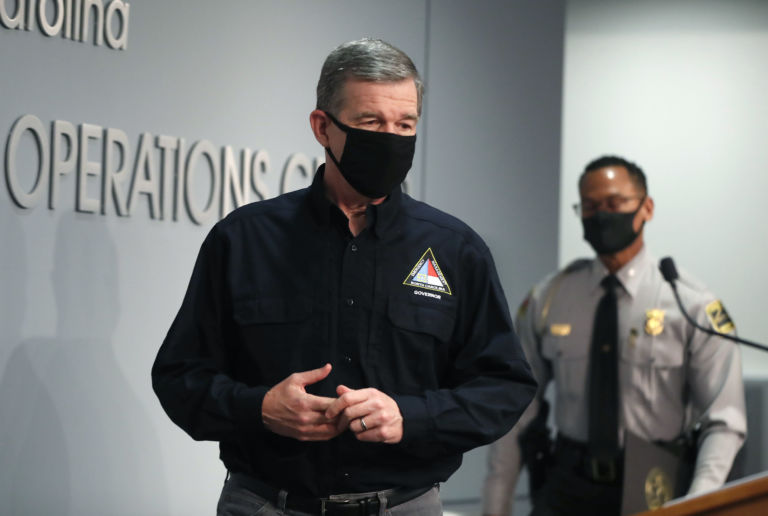
Newly released records are raising questions about how former Democrat Gov. Roy Cooper handled one of the biggest decisions North Carolina faced during COVID, and why the public wasn’t told what was happening behind the scenes.
On July 1, 2020, Cooper was expected to tell parents, teachers, and school districts how North Carolina’s public schools would reopen that fall, Instead, he delayed the decision by two weeks.
At the time, Cooper didn’t offer much of an explanation for the delay. But we now know that just two days earlier, he had a 45-minute conversation with Dr. Anthony Fauci about exactly that issue. Fauci, then the director of the National Institute of Allergy and Infectious Diseases, was one of the federal government’s most visible faces in the response to the COVID pandemic.
According to Fauci’s private diary, recently released by the US Senate Committee on Homeland Security and Governmental Affairs, Cooper called him on June 29, 2020, to talk about reopening schools.
“Gov Ray [sic] Cooper (D-NC) called me and spoke for 45 minutes on his dilemma,” Fauci wrote. “He was agonizing since he wanted to do the right thing. Since this is the first decision among Governors regarding opening for the Fall term, he feels that he will be the example … I recommended that he delay decision for 2 weeks.”
There was no public explanation in the July 1, 2020, press conference that Fauci had personally recommended postponing the decision.
“Let me be clear, we want our schools open for in-person instruction in August,” said Cooper at the time. “The classroom is the best place for children to learn, recent reports recommend it, and I know many parents and children agree with this. School is where children learn academics, but it’s also how they build their social skills, get reliable meals, stay physically fit, and really become tomorrow’s leaders. We’re not issuing a statewide directive today on how school should open in the fall, but we will soon.”
Donald Bryson, president and CEO of the John Locke Foundation, said the new revelations raise serious questions about why North Carolinians were kept in the dark at the time.
“North Carolinians should not have to wait six years and read Dr. Fauci’s private diary to learn what advice was shaping a decision that affected 1.5 million public school students,” Bryson told Carolina Journal. “Gov. Cooper was entitled to seek expert advice, but the public was entitled to know whose advice he was following and why. The John Locke Foundation warned at the time that delaying the decision on reopening would leave school districts unprepared. Unfortunately, the years since have shown that concern was well founded. The learning losses that followed make transparency and accountability for how those decisions were made all the more important.”
When Cooper announced his reopening framework on July 14, 2020, districts could operate under a hybrid model with reduced classroom capacity or choose entirely remote instruction. They could not reopen schools normally at full capacity. The result was that the overwhelming majority of North Carolina’s approximately 1.5 million public school students began the 2020-21 academic year without full-time classroom instruction.
Lindalyn Kakadelis was the founding executive director of the NC Coalition for Charter Schools at the time and currently serves on the NC Charter School Review Board. She told Carolina Journal Cooper’s handling of school reopenings created chaos for families and contributed to consequences still being felt today.
“The 2020 opening of schools was totally chaotic for students, parents, and local boards of education. Gov. Cooper left folks hanging while he continued to close all public schools at the beginning of the 2020-21 school year,” Kakadelis said. “Little did anyone know that Gov. Cooper was having private conversations with Dr. Fauci, which must have greatly influenced his decisions. Meanwhile ignoring what others were saying.”
In early 2021, the General Assembly made multiple attempts to force Cooper’s hand on reopening schools for full in-person learning. Cooper vetoed multiple bills before ultimately reaching a compromise with Republican lawmakers on March 11, 2021.
“The controversy spilled over into 2021 when Cooper repeatedly vetoed bipartisan bills passed by the General Assembly that attempted to legally mandate school reopening. Gov. Cooper abused his emergency executive powers, leading to years of litigation, “Kakadelis told Carolina Journal. “The state was left with substantial learning losses that is even evident today. The academic toll and social and mental health concerns continue to follow these students, and there is no way to know the total consequences of Gov. Cooper’s ideological overreach.”
In the years since COVID, reports from the North Carolina Department of Public Instruction have consistently shown significant learning loss across the state’s public school systems.
Carolina Journal reached out to the president and vice president of the North Carolina Association of Educators for comment but did not receive a response by the time of publication.
“Six years later, new details emerge about Cooper’s school reopening delay” was originally published on www.carolinajournal.com.

![[WBT107.9FM] app promo graphics 2025](https://wbt.com/wp-content/uploads/sites/84/2025/12/17653898024341.jpg?quality=80&strip=all&w=150&crop=0,0,100,150px)