4th Circuit rules against arrested Raleigh COVID protester
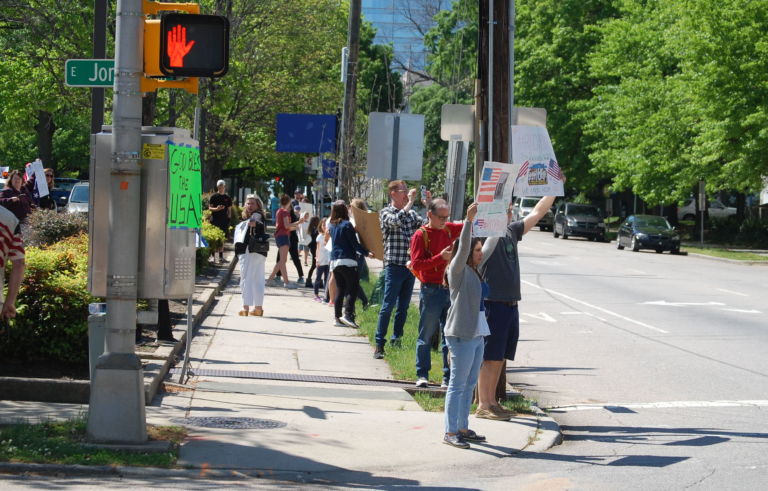
The 4th US Circuit Court of Appeals has ruled against a woman challenging her arrest near the North Carolina Executive Mansion in Raleigh during a COVID shutdown protest in 2020.
The state Appeals Court will hear oral arguments next week in a state court lawsuit stemming from the same arrest.
“Monica Ussery was arrested at an April 2020 protest against North Carolina’s COVID-19 emergency orders,” according to Friday’s unsigned and unpublished 4th Circuit opinion. “Ussery later sued various officials, as well as the City of Raleigh, asserting claims under 42 U.S.C. § 1983 and state law. The district court dismissed Ussery’s second amended complaint on several independent grounds.”
US District Judge Terrence Boyle issued his dismissal order in June 2024.
“On appeal, Ussery argues that the district court erred by: (1) holding that she failed to plausibly allege a conspiracy and constitutional violations; (2) holding the individual defendants were entitled to qualified immunity; and (3) dismissing her claim against the City,” the 4th Circuit opinion continued. “Having carefully reviewed both the district court’s decision and Ussery’s arguments, we conclude Ussery has failed to establish any reversible error. We thus affirm the district court’s judgment.”
Judges Allison Jones Rushing, Toby Heytens, and Barbara Milano Keenan made up the 4th Circuit panel that rendered Friday’s unanimous decision.
A three-judge North Carolina Court of Appeals panel will hear oral arguments Wednesday in Ussery v. Cooper, a state court case based on Ussery’s 2020 arrest.
A trial judge ruled in April 2025 that Ussery could proceed with her complaint against the city, its police chief, and a police captain. The same court order allowed Ussery’s case to proceed against the state, the State Capitol Police chief, and one State Capitol Police officer. The order dismissed the governor, Department of Public Safety secretary, Wake County district attorney, and two other law enforcement officers from the complaint.
Ussery claimed in her lawsuit that officials violated her rights when they arrested her and proceeded with a prosecution that extended for nearly three years.
“This case arises from a conspiracy formed by a group of state and local officials to pervert the criminal justice system, in violation of Articles 12, 14, and 19 of the North Carolina Constitution,” Ussery’s lawyers wrote in an April 2025 brief. “Defendants’ actions were designed to stifle public demonstrations against the government’s Covid-19 policies by arresting those who publicly challenged the unprecedented invocations of governmental power, which profoundly impacted the lives of every citizen in the State of North Carolina.”
“Defendants found their target in Ms. Ussery, the last remaining protestor at the first ReOpenNC protest on April 14, 2020 (the ‘Protest’), who was arrested after all other protestors had dispersed, while standing alone in a traditional public forum, a government parking lot which is part of the State Capitol Complex across from the legislative building,” Ussery’s lawyers added. “And their punitive, retaliatory campaign against Ms. Ussery continued long after the Protest, spanning three years, even though other protestors who supported more favored causes, including the Governor himself, were either not arrested, charged, or had their charges dismissed.”
Convicted in Wake County District Court on charges of second-degree trespass and violating then-Gov. Roy Cooper’s COVID shutdown Executive Order 121, Ussery eventually accepted a deal to have charges dismissed in return for 25 hours of community service. Charges were dismissed in February 2023, nearly three years after the protest.
Lawyers representing the governor and leaders of the state Department of Public Safety, State Capitol Police, and General Assembly Police filed a brief urging the court to dismiss Ussery’s complaint.
“Plaintiff seeks monetary damages from numerous defendants employed by different state and municipal entities for the performance of their official duties during the beginning of the COVID-19 pandemic,” wrote Special Deputy Attorney General Matthew Tulchin. “She alleges that collectively the Defendants violated her rights to freedom of assembly, freedom of speech, equal protection, and due process as protected under the North Carolina Constitution. She also alleges that all Defendants conspired together to deprive her of those rights. Plaintiff’s allegations are implausible and fail to state a claim.”
“Plaintiffs conspiracy claim fails because, even assuming her allegations demonstrated there was an agreement amongst all Defendants, she failed to allege any facts that plausibly show an agreement amongst all the defendants to deny her constitutional rights or any illegal overt acts in furtherance of such a conspiracy,” Tulchin wrote.
Ussery’s freedom of speech claim “fails for numerous reasons,” the court filing continued. “As an initial matter, freedom of speech is not an issue in this case because EO 121 and the law of trespass involve the regulation of conduct, not protected speech. Moreover, even if freedom of speech was an issue, her claim fails because EO 121 was content and viewpoint neutral and narrowly tailored to serve a substantial government interest – the protection of the public’s health and safety by reducing the spread of a deadly disease.”
“Plaintiff’s equal protection and due process claims fail because the police officers had probable cause to arrest Plaintiff and she has failed to adequately allege that the State Defendants treated her differently than similarly situated people, let alone intentionally and deliberately discriminated against her based on her speech (or were otherwise motivated by discriminatory intent),” state defendants argued. “Finally, even if Plaintiff could plausibly allege any state constitutional claims against the State Defendants, those claims are barred by governmental immunity.”
Boyle explained in 2024 why he dismissed Ussery’s federal case.
“EO 121, the Wake County Proclamation, and the alleged policy of the City of Raleigh that protesting is not an essential activity all arose during the early weeks of a global pandemic which, as Ussery has alleged, ‘turn[ed] the world upside down,’” Boyle wrote. “Ussery was arrested and prosecuted for violating the restrictions on mass gatherings outlined in EO 121 and subsequently charged with second degree trespass.
“She alleges, for example, that EO 121 and the City of Raleigh’s policy violated her First Amendment right to free speech. She further alleges that defendants retaliated against her for engaging in peaceful protest and publicly dissenting from the governor’s policies and executive order, in violation of the First Amendment,” Boyle wrote. “In opposition to the motions to dismiss, Ussery also defines the rights violated at a low level of particularity, citing, generally, bedrock and fundamental First Amendment, due process, and equal protection principles.”
“But none of the cases on which Ussery relies, … include circumstances that resemble those present in this case: a newly effective executive order and proclamation placing limits on mass gatherings in order to slow the spread of a global pandemic,” the judge wrote. “For this reason, ‘courts across the country have addressed qualified immunity for government officials at the 12(b)(6) stage regarding Covid-19 measures and found government officials to be immune from suit in their personal capacities.’”
“This Court has been presented with no controlling case or consensus of non-controlling authority which would support a determination that every reasonable officer or state official would understand that enforcing EO 121, the Wake County Proclamation, or the City’s alleged policy as against Ussery after the world had been turned upside down by a highly transmissible virus would violate her constitutional rights,” Boyle wrote.
“4th Circuit rules against arrested Raleigh COVID protester” was originally published on www.carolinajournal.com.
![[WBT107.9FM] app promo graphics 2025](https://wbt.com/wp-content/uploads/sites/84/2025/12/17653898024341.jpg?quality=80&strip=all&w=150&crop=0,0,100,150px)