Federal hemp fight puts Budd at center of debate also dividing NC legislature

Sen. Ted Budd, R-NC, led an unsuccessful effort last week to amend the US Senate’s continuing resolution to keep sweeping new federal restrictions on intoxicating hemp products on track to take effect Nov. 12.
Section 2019 of the Senate continuing resolution temporarily delays the application of those changes until Dec. 11. Budd’s proposed amendment, S.Amdt. 6747, would have struck Section 2019. Had it been agreed on, Congress would have left the broader Nov. 12 effective date intact.
The proposed amendment was defeated on Aug. 8, when senators voted 61-32 to table it. The 32-vote bloc opposing the motion to table crossed party lines, with 21 Republicans and 11 Democrats.
Budd had accumulated 14 cosponsors before the vote, including Sens. Thom Tillis, R-NC; Kirsten Gillibrand, D-NY; John Cornyn, R-Texas; Chuck Grassley, R-Iowa; Pete Ricketts, R-Neb.; and Mitch McConnell, R-Ky.
The fight centered on a federal hemp crackdown Congress approved in November 2025. The law changes the federal definition of hemp to account for total THC and excludes final hemp-derived cannabinoid products containing more than 0.4 milligrams of combined total THC and similar cannabinoids per container. Those changes are scheduled to take effect 365 days after the law was enacted, on Nov. 12, 2026.
Budd made protecting children the centerpiece of his argument, saying on the Senate floor that the availability and marketing of intoxicating hemp products had created a public-safety problem Congress already voted last year to address.
“Every parent in America wants the same thing: to know their child is safe,” Budd said, speaking in favor of the amendment on the Senate floor. “As United States senators, each of us has a responsibility to the millions of parents we represent to put the safety and welfare of American children first. That is exactly why, just nine months ago, 76 members of this body voted to close the hemp loophole that allowed these dangerous substances to be sold in unregulated retail stores.”
Budd pointed to the widespread availability of intoxicating hemp products in everyday retail stores as a central reason for allowing the restrictions to take effect.
“But since last November, the intoxicating hemp industry has attempted to delay our effort to close this dangerous loophole,” Budd said. “These companies want to continue selling intoxicating THC substances, loosely labeled as ‘hemp’ products, on the shelves of local convenience stores, gas stations, and grocery stores nationwide.”
Budd also raised concerns that some intoxicating hemp products are packaged and marketed in ways designed to resemble familiar snacks and candy consumed by children.
“The packaging is unmistakably designed to appeal to children, using bright colors and intentionally mimicking popular snack food and candy brands,” Budd added. “But what is most concerning is how easy it is for a child to walk into a convenience store and pick up what looks like their favorite snack or candy — without realizing they’re actually buying an intoxicating substance.”

Budd cited North Carolina data showing cannabis consumption-coded emergency department visits among minors increased 969% between 2017 and 2025. In doing so, he characterized the issue as a public-health crisis.
The North Carolina senator’s push placed him at odds with the White House.
The Associated Press reported that President Donald Trump personally called Budd as the dispute developed. Budd spokesman Christian McMullen later told AP that the two had a “friendly phone call” that included the hemp issue and that Budd explained his opposition to any delay. McMullen said Trump did not explicitly ask Budd to withdraw the amendment. The administration has supported the temporary extension while pursuing a broader framework for hemp and cannabinoid products.
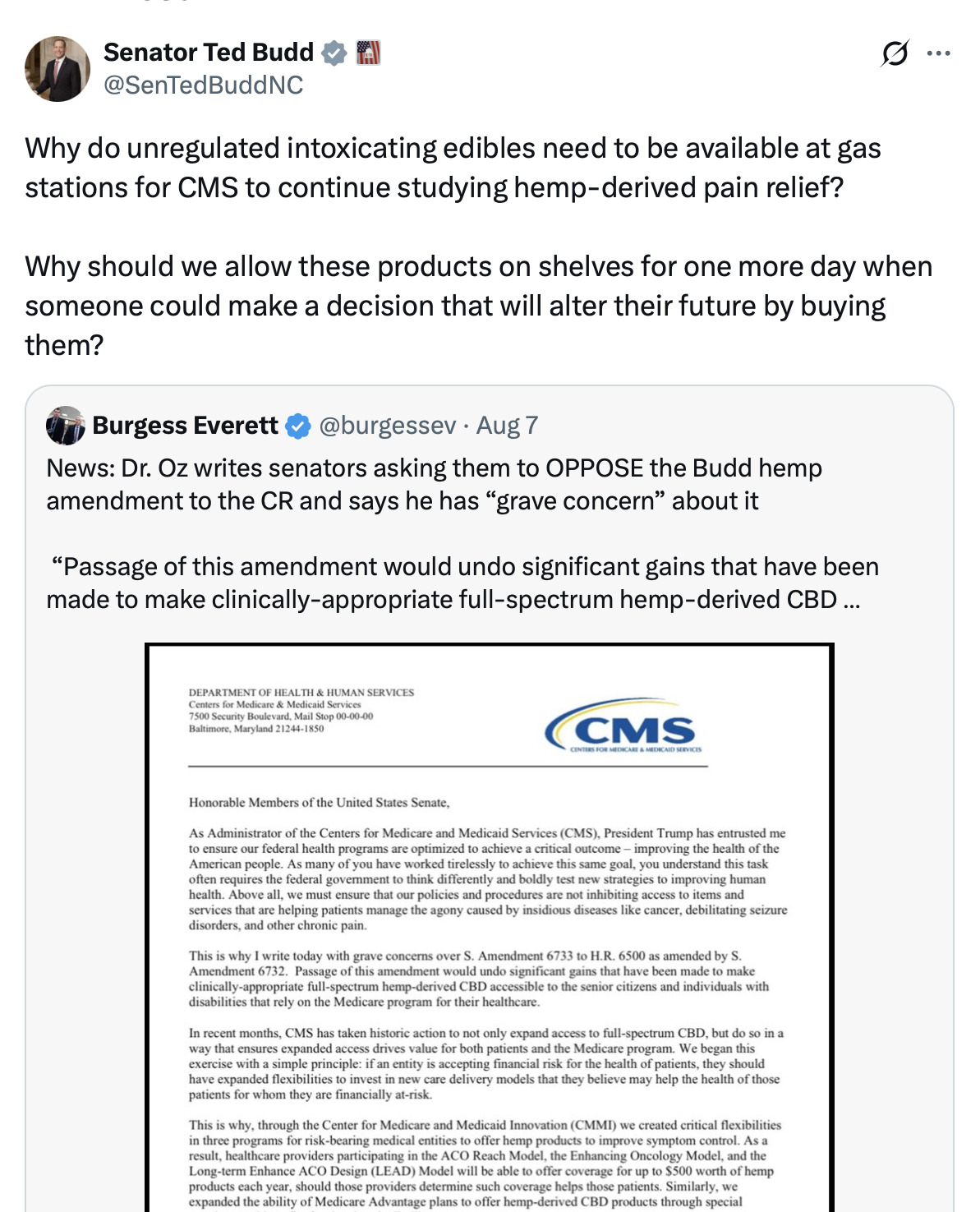
Centers for Medicare and Medicaid Services Administrator Dr. Mehmet Oz also urged senators to reject the proposal in a public letter, arguing that allowing the broader hemp restrictions to take effect on Nov. 12 could disrupt recent CMS efforts to expand access to clinically appropriate full-spectrum hemp-derived CBD for seniors and people with disabilities.
Budd publicly pushed back on that argument, questioning why preserving medical access to CBD required continued retail availability of intoxicating hemp products.
The hemp fight also exposed divisions among Senate Republicans over whether to allow the restrictions to take effect on schedule or give the administration more time to pursue an alternative regulatory approach.
Axios reported that the disagreement spilled into a closed-door Senate Republican lunch, where Budd, Ricketts, and Sen. Tom Cotton, R-Ark., argued for allowing the restrictions to take effect as scheduled. During the lunch, which grew tense, White House legislative affairs official James Braid told senators that the administration would not seek another extension beyond the one contained in the continuing resolution.
In an Aug. 6 letter to Senate Majority Leader John Thune, R-SD; and Minority Leader Chuck Schumer, D-NY, 105 organizations said they supported the hemp language in the continuing resolution and opposed Budd’s effort to remove it.
The opponents of Budd’s amendment argued that the 30-day delay would give Congress time to regulate the hemp market rather than allow the broader restrictions to take effect as written.
The coalition included several North Carolina groups — the NC Craft Brewers Guild, North Carolina Cannabis Chamber, North Carolina Healthy Alternatives Association, and North Carolina Hemp Businesses for Responsible Regulation — along with national organizations including the US Hemp Roundtable, National Restaurant Association, and the National Association of Convenience Stores.
The groups argued that the additional month could give lawmakers time to pass legislation imposing stronger regulation on the market, including measures aimed at keeping dangerous products away from children, blocking imports of synthetic cannabinoids from China, and establishing good manufacturing practices.
After Budd’s amendment was tabled, the Senate passed the underlying continuing resolution 90-6. Budd voted for the final spending package despite losing the hemp fight.
The dispute in Washington comes as North Carolina lawmakers remain deadlocked over legislation that would directly incorporate much of the same federal hemp standard into state law.
House Bill 328, Regulate Hemp-Derived Consumables, would prohibit finished hemp-derived consumable products containing more than 0.4 milligrams of total THC per container, along with products containing synthetic or chemically converted cannabinoids. The restrictions would remove most THC beverages, gummies, vapes, delta-8 products, and THCA flower from North Carolina’s legal market beginning Nov. 12.
The bill would also make it illegal to sell or deliver hemp-derived consumable products to anyone younger than 21 and prohibit underage possession.
The Senate adopted the conference report 37-6 on July 2, but the House has repeatedly declined to take it up. The agreement was formally returned to the House Rules Committee on July 30, where it remained after lawmakers left Raleigh last week without taking action.
That hesitation came despite a concerted push from law enforcement groups and Republican lawmakers who argued the measure is necessary to keep intoxicating products away from children.
Hundreds of hemp business owners, employees, and consumers pushed in the opposite direction, arguing that lawmakers should regulate products through age limits, testing, labeling, and packaging requirements rather than effectively removing most of the existing market.
House Speaker Destin Hall, R-Caldwell, said lawmakers broadly agree that North Carolina’s largely unregulated market cannot continue but remain divided over the solution. He said he plans to assemble a smaller group of lawmakers to continue working on the issue before the end of the year.
HB 328 would place the 0.4-milligram limit directly into North Carolina law rather than merely rely on the federal definition of hemp. That means the state prohibition could remain in place even if Congress delays, rewrites, or ultimately backs away from the federal restrictions.
For now, neither the federal delay nor the proposed North Carolina restriction has reached the finish line, leaving lawmakers wrestling with the question of whether to prohibit much of the intoxicating hemp market under a strict THC threshold or replace that approach with a broader regulatory system.
“Federal hemp fight puts Budd at center of debate also dividing NC legislature” was originally published on www.carolinajournal.com.


![[WBT107.9FM] app promo graphics 2025](https://wbt.com/wp-content/uploads/sites/84/2025/12/17653898024341.jpg?quality=80&strip=all&w=150&crop=0,0,100,150px)