NC Appeals Court wrestles with vacated murder charges in 2002 case
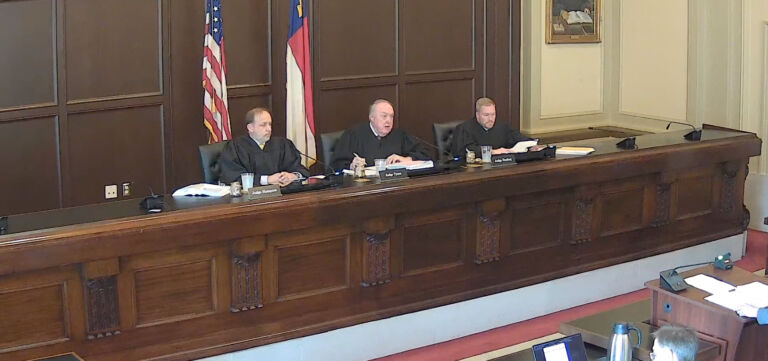
The North Carolina Court of Appeals will decide in the months ahead whether a trial judge had the authority to vacate murder convictions and dismiss charges related to a 2002 killing in Winston-Salem.
The decision will determine whether two men serving life prison sentences on murder convictions will remain behind bars.
The case has attracted extra attention because 61-year-old victim Nathaniel Jones was pro basketball star Chris Paul’s grandfather.
Appellate judges heard oral arguments in the case Tuesday.
Superior Court Judge Robert Broadie issued an August 2025 order throwing out the convictions and charges against Rayshawn Denard Banner, Nathaniel Arnold Cauthen, Christopher Levon Bryant, and Jermal Matthew Tolliver. Broadie dismissed the case “with prejudice,” meaning that authorities could not move forward with new trials against any of the defendants.
Bryant and Tolliver completed their original prison sentences in 2017, but Banner and Cauthen remain behind bars.
An October 2025 state Supreme Court order stayed Broadie’s ruling until the Appeals Court could hear the case.
All four defendants were juveniles in 2002 when Jones was attacked while unloading groceries at his Winston-Salem home.
State Special Deputy Attorney General Heidi Williams labeled Broadie’s decision “error” during Tuesday’s arguments. Broadie compounded that error by not ordering a new trial, the only option available to the defendants in the context of the legal proceeding, Williams argued.

Broadie instead ordered “a drastic remedy that was not authorized by North Carolina law,” Williams added.
“At the very least, the [district attorney]’s office should be allowed to re-prosecute these cases if it seeks that they need to be,” added Special Deputy Attorney General Nicholaos Vlahos. “It’s their constitutional duty to do so.”

Broadie made his decision based on recanted witness testimony, new DNA evidence, and arguments about forced confessions from juvenile suspects. The defendants’ current lawyers also blamed earlier lawyers for providing ineffective assistance.
“The trial court found there was no path to retrial and conviction beyond a reasonable doubt,” lawyer Brad Bannon argued Tuesday on behalf of the defendants.

Bannon also defended Broadie’s authority to dismiss the cases against the four defendants. “That authority is clear under the statute,” he argued. “It’s right there.”
“If there’s evidence to support the trial court’s determination, what role do we have to simply throw out those weighing determinations?” Judge Toby Hampson asked at one point.
“Don’t we have to have faith that our Superior Court judges are hearing the evidence presented, … finding facts based on that evidence, and weighing that?” Hampson also asked. “Where does the statute limit the trial court’s discretion to determine the appropriate relief?”
Hampson and Judges John Tyson and Michael Stading face no deadline to reach a decision in the case.
“First and foremost, the trial court’s order exceeded the scope of relief allowable under the law,” state Justice Department lawyers wrote in a January Appeals Court brief. “Even assuming Defendants were successful on any of their [motion for appropriate relief] claims, the trial court lacked authority to grant dismissal of the charges with prejudice. Instead, the only remedy for the claims Defendants presented in their MARs is ordering a new trial. On this point alone this Court should reverse.”
“Abundant caselaw in North Carolina makes clear a new trial — not dismissal of all charges with prejudice — is the correct remedy when a defendant presents a meritorious claim of newly discovered evidence, recantation evidence, or ineffective assistance of counsel,” the state’s brief added.
“The policy implications of the trial court’s extraordinary grant of relief here are profound,” state lawyers argued.
“Here, the MAR court undermined the prosecutor’s constitutional authority and discretion by dismissing Defendants’ charges with prejudice where such relief was not authorized pursuant to any of the claims Defendants brought in their MARs,” according to the state’s brief.
The state noted that a three-judge Superior Court panel had considered the defendants’ case in 2022 in connection with the North Carolina Innocence Inquiry Commission. The panel “ruled unanimously that Defendants failed to present clear and convincing evidence they were actually innocent and dismissed their claims,” state lawyers wrote.
“Accepting Defendants’ position would mean a single superior court judge, decades after Defendants’ convictions, could order their unconditional and unreviewable release, despite that Defendants were duly convicted by juries of their peers, failed to demonstrate innocence before the NCIIC, and when no sufficiency-of-the-evidence claims were before the court on which to base such an acquittal,” Justice Department lawyers argued. “Such a remedy is unprecedented and conflicts with North Carolina law.”
The North Carolina Center on Actual Innocence represents Banner and Cauthen. The Wake Forest law school’s Innocent and Justice Clinic represents Tolliver.
“On 15 November 2002, assailants attacked and robbed Nathaniel Jones in his carport in Winston-Salem,” lawyers for all four defendants wrote in a March Appeals Court brief. “They bound his hands behind his back and covered his mouth with black tape. He died from cardiac arrhythmia brought on by the stress of the attack.”
“On 19 November 2002, the Winston-Salem Police Department (‘WSPD’) rounded up and interrogated Defendants and another neighborhood boy,” the defendants’ lawyers wrote. “All were fourteen or fifteen years old and fell within the intellectual functioning range of elementary school children. When WSPD learned they were with sixteen-year-old Jessicah Black on 15 November 2002, they also interrogated her.”
“All six teenagers initially told WSPD they had no knowledge of or involvement in the attack on Jones, but they eventually confessed after being subjected to interrogation tactics now known through decades of scientific research to produce false confessions, particularly in juveniles,” the defense lawyers argued. “WSPD recorded only the final moments of confession. The boys were then charged with murder, and Black was let go. Since then, Defendants have maintained they are innocent and falsely confessed.”
“The prosecution of Defendants stood on two pillars: the confessions and Black’s testimony,” the brief continued. “Nevertheless, despite filing motions to suppress the confessions, Defendants’ trial counsel failed to investigate their cognitive impairments and vulnerabilities to false confession. Suppression was denied, and Defendants were convicted.”
“In 2023, Defendants filed motions for appropriate relief (‘MAR’s) based on ineffective assistance of counsel (‘IAC’) and newly discovered evidence: (1) Black’s recantation of her trial testimony; (2) DNA evidence excluding them from the profiles on the binding around Jones’s hands; and (3) advancements in juvenile false confession science,” the defense lawyers wrote.
Broadie held a three-week hearing in 2025 before ruling in favor of the defendants.
“On the newly discovered evidence claims, the court was satisfied Black’s trial testimony was false; found the DNA to be compelling evidence Defendants did not commit the crime; and found the advancements in juvenile false confession science to be compelling evidence the confessions were false,” the defense lawyers wrote. “The court concluded a different result would have probably been reached at trial without Black’s false testimony or with the DNA or juvenile false confession evidence.”
“On the IAC claims, the court found trial counsel’s failures to investigate, among other deficiencies, prejudiced Defendants at the suppression hearings and trials,” the brief continued. “On the remedy, with both pillars of prosecution collapsed, the court dismissed the charges.”
“NC Appeals Court wrestles with vacated murder charges in 2002 case” was originally published on www.carolinajournal.com.


![[WBT107.9FM] app promo graphics 2025](https://wbt.com/wp-content/uploads/sites/84/2025/12/17653898024341.jpg?quality=80&strip=all&w=150&crop=0,0,100,150px)