Stein pulls Smythe DPS nomination, blames NC Senate for inaction
On Monday, Gov. Josh Stein withdrew his nomination of Jeff Smythe as the North Carolina Department of Public Safety (NC DPS) secretary and instead has appointed him to be the senior advisor for Homeland Security in the governor’s office.
Smythe had been serving as the interim secretary since January after the retirement of former NC DPS secretary Eddie Buffaloe.
The governor has appointed NC DPS Chief of Staff Casandra Hoekstra to serve as interim secretary while a search is conducted to find the next permanent secretary.
Stein, a Democrat, laid the blame for the change of plans at the state Senate’s feet.
“Jeff Smythe is a dedicated public servant and decorated law enforcement leader who has spent his 40-year career focused on keeping people safe,” he said in a press release. “That’s why I nominated him to serve as Secretary of the Department of Public Safety more than seven months ago. Yet by failing to consider his nomination or even hold a single public hearing, the Senate abdicated its responsibility, disrespected Jeff and law enforcement, and undermined the safety of the people of North Carolina. Their failure to do their jobs is unacceptable.”
The Senate Judiciary Committee leaders had been reviewing ethics compliance, potential conflicts of interest, and a history of progressive policing policies ahead of confirming Smythe to lead NC DPS.
A spokeswoman for Senate Republicans told the Carolina Journal that Smythe’s record raises broader questions about the department’s direction.
“Safety and security are top of mind for most North Carolinians,” the spokeswoman said. “They want to feel safe whether they’re at home or out and about living their daily lives. They deserve a Department of Public Safety Secretary who is laser-focused on protecting them and locking up violent criminals, not generating ‘feel good’ headlines or kowtowing to far-left activists.”
“Politics should never get in the way of our work to create a safer, stronger North Carolina,” Stein concluded in his press release. “I certainly won’t let it.”
NCDPS oversees major state public safety functions, including prisons, emergency management, highway patrol, and local agency coordination.
Smythe is a former Burlington police chief and current city council member.
Before joining the state government, he led the Burlington Police Department for eight years. His previous official DPS biography said his tenure in Burlington included initiatives focused on officer wellness, preparedness, de-escalation, implicit bias, and behavioral-health resources.
Smythe’s career also includes leadership roles in national and state law enforcement organizations. His Burlington City Council biography lists him as a former vice president of the North Carolina Association of Chiefs of Police, former president of the International Association of Directors of Law Enforcement Standards and Training, a commissioner for the Commission on Accreditation for Law Enforcement Agencies, and a life member of the International Association of Chiefs of Police and Police Executive Research Forum.
Senators sent a letter to him on May 15, citing Smythe’s service as acting DPS secretary and as a member of the Burlington City Council as a potential conflict.
Smythe pushed back in a May 22 response, telling the senators that the State Ethics Commission had been made aware of his Burlington City Council role and “determined that my service on the Council does not create a conflict of interest.” Smythe also said he had discussed potential conflicts with his general counsel and that no conflict had arisen to date.
Lawmakers had received letters of support from police leaders across the state, according to materials reviewed by Carolina Journal. The letters pointed to Smythe’s decades in law enforcement, his tenure as Burlington police chief, and his work overseeing law-enforcement standards at the Department of Justice.
Taken together, critics believed the ethics letter, Smythe’s response, and the need for expressed support highlighted two core conflicts at the center of his confirmation: whether Smythe could serve effectively as both a local elected official and a state public-safety chief, and whether his record aligns more with mainstream law enforcement or an activist-driven policing agenda post-2020.
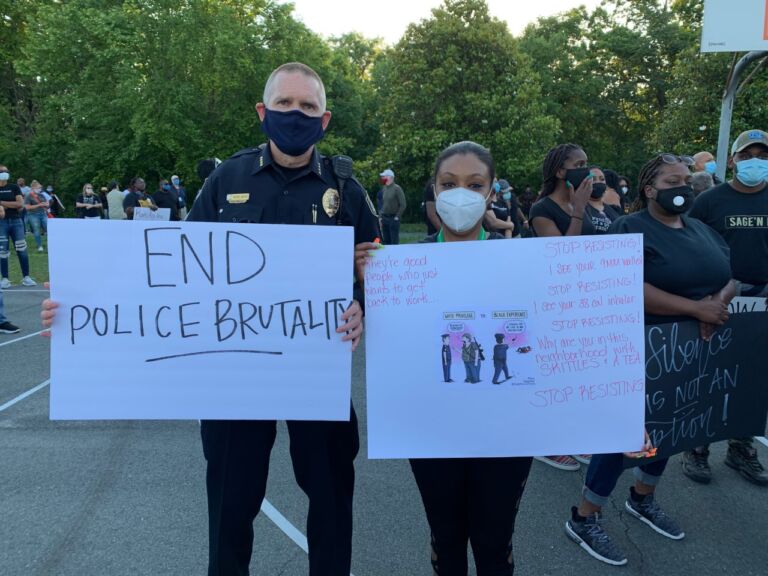
In June 2020, Smythe attended a George Floyd protest at North Park in Burlington and accepted a sign reading “End Police Brutality.” Smythe brought the sign back to the department so officers on duty could pose with it in a show of solidarity with protesters.
There were also many other progressive policing policies raised from Smythe’s tenure.
In a letter to the #8Can’tWait campaign, Burlington police said the department met or exceeded the national campaign’s recommendations in several areas. The campaign, launched during the George Floyd protests, pushed police agencies to adopt policies such as banning chokeholds, requiring de-escalation, requiring warnings before shooting, and requiring officers to intervene when witnessing excessive force.
In a separate response to Alamance Agents for Change, a local activist group pressing law enforcement agencies to change policy and practice, Burlington officials addressed issues including use-of-force policy, transparency, officer discipline, and the handling of officers accused of misconduct or association with hate groups.
In that response, Smythe described several reform-oriented actions already underway at the department. He wrote that Burlington police had continued sending personnel to Racial Equity Institute training and said a grant would allow additional staff to attend.
The same materials say Smythe also pointed to a Burlington policy governing police contacts and searches involving transgender individuals, describing it as the first known policy of its kind in North Carolina and noting that it had been designed and vetted by the ACLU.
Role on racial equity task force
Smythe later became involved with the state-level Task Force for Racial Equity in Criminal Justice, known as TREC, as the director of the Criminal Justice Standards Division and a member of the Local Policy Committee.
Gov. Roy Cooper created the task force in June 2020 after George Floyd’s death, with Stein and then-NC Supreme Court Associate Justice Anita Earls as co-chairs. The task force was charged with examining racial disparities in the criminal justice system and recommending policy changes.
Critics believe TREC’s work went far beyond general calls for training or transparency. The task force eventually issued 125 recommendations touching nearly every stage of the criminal-justice system, including policing, officer discipline, school resource officers, juvenile justice, sentencing, incarceration, reentry, and victim services.
Andrew Pomeranz contributed to this article.
“Stein pulls Smythe DPS nomination, blames NC Senate for inaction” was originally published on www.carolinajournal.com.