Documents detail settlement of federal suit over juvenile confinement
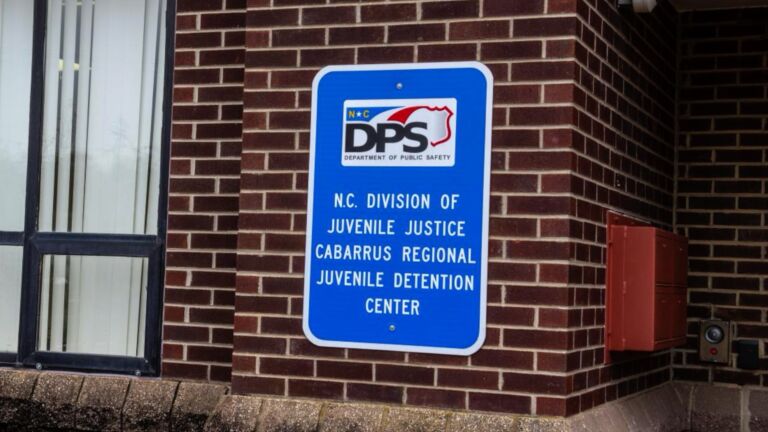
New documents offer details about the proposed settlement of a class-action lawsuit over solitary confinement of juveniles in North Carolina. A settlement hearing is scheduled Sept. 3 in Greensboro.
US Chief District Judge Catherine Eagles granted preliminary approval to the settlement in May.
Two anonymous former detainees and the North Carolina Department of Public Safety filed a joint motion Thursday for an order granting final approval.
Plaintiffs originally filed suit in 2024. They initially sought a class action challenging solitary confinement in juvenile detention facilities across North Carolina. Eagles issued an order last October limiting the class to detainees at the Cabarrus Juvenile Detention Center.
“The Proposed Settlement Agreement primarily addresses NCDPS’s use of room confinement at the Cabarrus JDC, the overall conditions of confinement at the Cabarrus JDC, and systems for ensuring compliance with the terms of the agreement,” lawyer Robert Lindholm wrote in a court filing connected to Thursday’s motion.
The settlement addresses both temporary room confinement and administrative room confinement, Lindholm explained. “These designations differ in name only: the end result is the same; under either designation, a juvenile is locked in his cell alone.”
Settlement provisions “represent a significant departure from NCDPS’s current policy” for temporary room confinement, “which allows NCDPS to place juveniles in room confinement ‘to protect the juvenile from himself; to protect others from the juvenile; to protect state or personal property from destruction by the juvenile; or to protect the security and/or orderly management of the detention center,’” Lindholm added.
The settlement provisions “adequately address allegations made in Plaintiffs’ Complaint” about TRC, he wrote.
“Plaintiffs believe that discovery has shown that NCDPS routinely imposes Temporary Room Confinement for extended periods of time even when juveniles no longer present (or never presented) a threat to others,” Lindholm argued. “Plaintiffs allege — and believe that discovery has demonstrated — that NCDPS staff members routinely impose room confinement for set periods of time in response to relatively minor rule infractions, such as juveniles trading snacks or talking back to staff members.”
While the settlement focuses on temporary room confinement, it “makes only minor changes to NCDPS’s ability to use what it terms Administrative Room Confinement for medical, weather, and security reasons,” Lindholm wrote. “This is because Plaintiffs did not challenge NCDPS’s use of these specific justifications for room confinement.”
“Plaintiffs have also not seen discovery materials suggesting that NCDPS’s use of these three forms of Administrative Room Confinement violates the U.S. Constitution,” he added. “Accordingly, Plaintiffs do not believe that leaving policies for such forms of Administrative Room Confinement intact impacts the benefits of the Proposed Settlement Agreement.”
The settlement addresses “overuse of room confinement to address staffing shortages,” Lindholm argued. “Based on their own experiences, discovery conducted in this matter, and Defendants’ representations, Plaintiffs believe that chronically low staffing is one of the root causes of NCDPS’s use of solitary confinement in the Cabarrus JDC.”
The Prison Rape Elimination Act requires the detention center to have one “certified staff member” for every eight juveniles who are outside their cells, Lindholm explained. Administrative confinement has helped the center meet that requirement “when staffing ratios dip below that level.”
The settlement “aims to help the Cabarrus JDC solve its staffing shortage and mitigate the impact on class members if the Cabarrus JDC drops below the 1:8 PREA ratio,” according to the court filing.
“I believe Plaintiffs have a strong case,” Lindholm argued. “If this case goes to trial, I expect Plaintiffs will elicit testimony proving that NCDPS kept Plaintiffs and other juveniles at the Cabarrus JDC in isolation for long periods of time and that such isolation harmed them, in violation of the Eighth and Fourteenth Amendments to the federal Constitution. Plaintiffs are, however, cognizant of the risk of trial.”
“I have no reason to believe that the class would receive meaningfully better relief after trial,” he added. “The risks of trial render settlement a reasonable way to ensure that the class’s constitutional rights are protected.”
“Upon consideration, the Court finds that the proposed settlement is likely to be approved as fair, reasonable, and adequate and that the parties’ proposed plan and schedule for notice, objections, and opting-out is appropriate,” Eagles wrote in a four-page order in May.
John Doe plaintiffs from 15 to 17 years old filed suit against the North Carolina Department of Public Safety in January 2024. They sought class-action status to cover all juveniles housed in DPS detention centers.
“Plaintiffs John Doe 1 and John Doe 2 were, at the time the complaint was filed, juveniles in state custody at the Cabarrus Juvenile Detention Center awaiting adjudication of charges against them,” Eagles wrote in her October order. “They allege that the state keeps them and other juveniles in solitary confinement for many hours a day and does not provide basic educational services. They challenge the constitutionality of these practices and seek declaratory judgment and injunctive relief on behalf of a class of all juveniles at all state juvenile detention centers or, in the alternative, juveniles at the Cabarrus Detention Center.”
“In its discretion, the Court will deny the motion for certification of a statewide class, given the commonality, typicality, and manageability problems that class would present,” Eagles added. “But the Court will certify a class of juvenile pretrial detainees held at the Cabarrus Juvenile Detention Center. As to this class, the plaintiffs have shown that a class action is an appropriate way to resolve the constitutional claims they raise.”
The class includes “[a]ll pre-adjudication juveniles who are currently, or in the future will be, detained in the Cabarrus Juvenile Detention Center,” Eagles explained.
The suit alleged “devastating and long-term effects” of keeping juveniles locked up by themselves.
“Over a decade ago, the Attorney General’s National Task Force on Children Exposed to Violence addressed the harmful effects of solitary confinement of children,” according to the complaint. “This practice was so prevalent and damaging that after an investigation by the United States Justice Department, President Obama banned the use of solitary confinement on juveniles in federal prisons in 2016.”
“Recognizing the harmful effects solitary confinement have on juveniles, over seven years ago, in June 2016, Defendant North Carolina Department of Public Safety (“NCDPS”) announced the end to solitary confinement for inmates in adult correctional facilities who were under 18 years of age,” the lawsuit added.
“Despite the overwhelming consensus that solitary confinement has devastating and long-term effects on juveniles, including depression, anxiety, suicide, psychosis, and post-traumatic stress disorder, and despite the abandonment of solitary confinement for juveniles throughout the country, NCDPS has embraced a policy, custom, and practice of solitary confinement of children as young as ten years old, who have not had their cases adjudicated yet, at juvenile detention centers across the state of North Carolina, including the Cabarrus Regional Juvenile Detention Center (the “Cabarrus Juvenile Jail”), for nearly 24 hours a day,” the complaint continued.
The suit pointed to negative impacts on juveniles’ education, behavior, and mental state.
“Solitary confinement has been proven dangerous for all ages, but is especially harmful for juveniles due to their developmental vulnerabilities,” according to the complaint. “It is well established that isolating children and thereby preventing children from having meaningful contact with others increases their risk of suicide and self-harm. For those children that have a mental health challenge or disability, the risk of harm can be even greater. Despite the known dangers to the children in their care and their admission of the harm that solitary confinement causes children, Defendants run the juvenile jails in North Carolina with inadequate staffing that predictably results in children being locked in their cells nearly 24 hours a day. Defendants have chosen this route in the face of public scrutiny and despite open discussions of the current conditions.”
The suit contended that solitary confinement violates the juveniles’ Eighth and 14th Amendment rights.
“Defendants must be immediately restrained from placing Plaintiffs and the Class in solitary confinement as punishment, discipline, or because there is inadequate staffing, and from placing Plaintiffs in solitary confinement for any reason other than a rare and temporary response to prevent imminent and serious physical harm to persons due to a juvenile’s behavior,” according to the suit.
“Documents detail settlement of federal suit over juvenile confinement” was originally published on www.carolinajournal.com.