Court orders new disciplinary proceeding for former Guilford judge
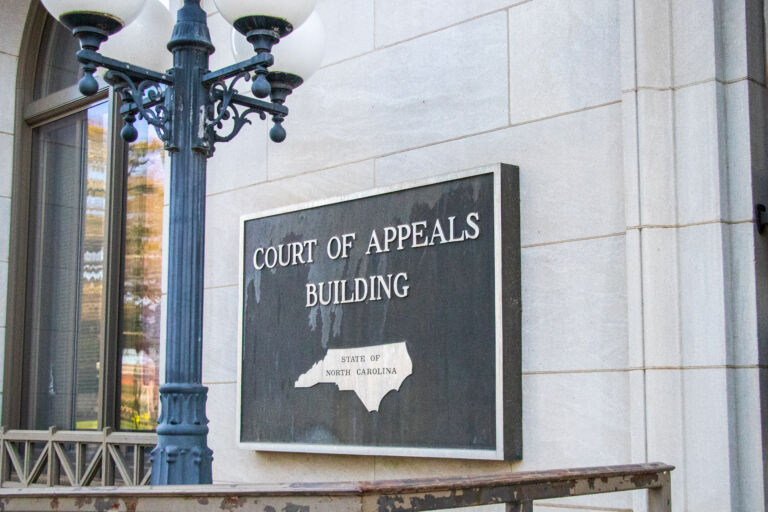
The North Carolina Court of Appeals has vacated an order suspending former Guilford County District Judge Mark Cummings’ law license for five years. Appellate judges agreed that the North Carolina State Bar’s disciplinary group made mistakes when addressing some accusations against Cummings.
Cummings attracted media attention in December 2019 when he resigned from the bench. The resignation followed “a state investigation into various actions of misconduct that lasted more than a year,” according to a News and Observer report. Cummings “agreed to resign from office and never run for a North Carolina judicial office again.”
The State Bar’s Disciplinary Hearings Commission issued a March 2024 order against Cummings that dealt with more than just his conduct on the bench. The law license suspension has been stayed during the course of his appeal.
“Some of the alleged violations occurred while Defendant was serving as a district court judge while others occurred while he was engaging in the practice of law,” Appeals Court Chief Judge Chris Dillon explained in a unanimous opinion filed Wednesday. “Because we conclude the DHC erred in its Order with respect to some of the violations it found, we affirm in part and vacate the Order and remand in part, for the DHC to reevaluate the appropriate discipline.”
“The DHC essentially determined Defendant committed numerous Rules violations in connection with (1) the compensation of certain individuals working at his law firm, (2) a misrepresentation he made to the trial court while representing a criminal defendant, (3) an act of dishonesty while presiding over a child support hearing, and (4) the action of falsely claiming his place of residence when filing for judicial candidacy,” Dillon wrote.
The first allegations involved the failure to provide 1099 tax forms to three people who worked at his law firm from 2014 to 2016. The Appeals Court agreed with the State Bar “that Defendant made a false statement in connection with this disciplinary matter.”
“We conclude, however, that the DHC’s findings do not support its conclusions that Defendant violated Rule 8.4(b) in connection with his failure of providing 1099s to the three individuals,” Dillon wrote. Appellate judges threw out that portion of the order suspending Cummings’ license.
The second allegation involved the State Bar’s conclusion that Cummings made “a false statement or misrepresentation to the judge presiding over a trial where he was representing a criminal defendant” in 2021.
During the trial, Cummings placed a recording device on a table during a witness’s testimony. “It appears he did so to ‘motivate’ the state witness not to testify contrary to what the witness had told him,” Dillon wrote.
Cummings had no recording of the witness, and the disciplinary group accused him of making a false statement to the judge about having a recording.
“[T]he record lacks evidence supporting the DHC’s underlying assumption that Defendant’s action of taking out the recording device was directed towards the tribunal constituting a Rule 3.3(a)(1) violation,” Dillon explained. “Instead, various exchanges between Defendant, the judge, and the state’s attorney indicate Defendant’s action may have been trial strategy directed towards the witness.”
“[T]he record fails to support the DHC’s conclusions Defendant engaged in dishonest conduct or conduct prejudicial to the administration of justice,” the Appeals Court opinion continued.
The third allegation against Cummings involved his work as a judge. He had a “work note” prepared for a father involved in a child custody hearing. While the father appeared for one day in Cummings’ court, the note indicated that he had been present for three days.
Cummings’ action appeared to be “an attempt to assist the defendant-father to evade the consequences of violating his probation (i.e., leaving the state of Virginia) by coming to North Carolina to see his child,” Dillon wrote.
The work note issue helped contribute to an October 2019 consent order between Cummings and the Judicial Standards Commission. That order included Cummings’ agreement to step down as a judge, Dillon explained.
“Defendant argues the State Bar lacks the authority to discipline him for his alleged dishonest act regarding the work note where the JSC has already disciplined him for that same action, resulting in him resigning from his judgeship,” the Appeals Court opinion added.
“We conclude the fact that another disciplinary board — in this case the JSC — took action against Defendant for a dishonest act does not prevent the State Bar from taking disciplinary action concerning Defendant’s license issued by the State Bar to practice law, where it properly determines the dishonest act is one ‘that reflects adversely on the lawyer’s fitness as a lawyer,’” Dillon wrote.
The fourth allegation involved disputes about Cummings’ residency when he planned to run for a Superior Court seat in 2018.
“Essentially, the DHC found Defendant deliberately lied about his place of residency so that he could run for a particular judicial seat,” Dillon wrote. “Here, we conclude the DHC erred because its findings were not supported by competent evidence in that the DHC impermissibly relied on non-competent hearsay.”
The dispute about Cummings’ proper address involved the timing of his move out of the home he had shared with his wife.
“[T]he record lacks competent evidence supporting the DHC findings and conclusion that Defendant misrepresented his residence on his judicial candidacy form, driver’s license form, and voter registration,” the Appeals Court opinion explained. “Thus, we vacate the Order as to Defendant’s violations of Rules 8.4(b), 8.4(c), and 8.4(d) for this issue.”
Judges Allegra Collins and April Wood joined Dillon’s opinion.
“Court orders new disciplinary proceeding for former Guilford judge” was originally published on www.carolinajournal.com.


![[WBT107.9FM] app promo graphics 2025](https://wbt.com/wp-content/uploads/sites/84/2025/12/17653898024341.jpg?quality=80&strip=all&w=150&crop=0,0,100,150px)