Stein signs police retention, child protection bills into law
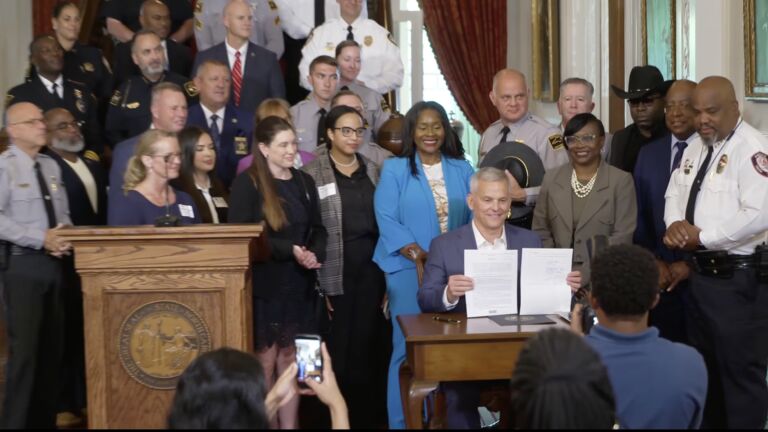
Gov. Josh Stein signed two bills into law on Thursday that focus on keeping communities and children safe.
House Bill 481, “Pay Exceptions/Special Separation Allowance,” builds on House Bill 50, “LEO Special Separation Allowances Options” which was signed into law by the governor last June and allows law enforcement officers toward the end of their careers to keep serving without losing their benefits.
HB 481 allows retired law enforcement officers to keep their separation allowance if they want to return to work if they serve in a different law enforcement capacity.
At a press conference on Thursday, Stein, a Democrat said he has heard from several police chiefs and sheriffs about their departments recruitment and retention challenges making the job even harder for those who serve and being stretched thin and being asked to do more with less.
“So, when we have veteran officers who are willing to raise their hand and say, ‘I will stay on the job,’ we should support them for a long time,” he said. “Law enforcement officers who had served their 30 years, but wanted to keep serving found themselves facing a tough financial choice if they kept working. They would lose out on thousands of dollars of compensation in their law enforcement special separation allowance.”
The governor said he advocated for HB 50 since his days as attorney general and was proud to sign it and HB 481.
“During my eight years as the chief in Burlington, I can think of a dozen or more officers and command staff members that were forced into retirement based on the economics of the old system,” NC Department of Public Safety Secretary Jeffrey Smythe said during the press conference. “This new formula provides real incentive for them to stay and continue to serve it is significant progress to our law enforcement officers across this state.”
HB 83, “Revise Laws on Minors/Human Trafficking,” protects minors from obscenity and predatory actors online. Specifically, it expands the criminal offense of disseminating obscene material to minors and requires courts to consider whether to require sex offender registration for those who are convicted.
Stein stated that approximately 96% of US teenagers say that they use the internet every day, and the share of teens who report being online almost constantly has increased by nearly two-thirds in recent years.
“When an old man sends a gross, lewd photo to a teenager, that person can now be held accountable under state law,” he said during the press conference. “It will also address the state’s response to the heinous crime of human trafficking. The North Carolina Human Trafficking Commission will dig in further on the feasibility of building a statewide reporting and response system to better combat human trafficking.”
Rep. Monika Johnson-Hostler, D-Wake, who is also the executive director of NC Coalition Against Sexual Assault, said that things have changed over the 30 years she has served in anti-sexual violence and human trafficking field, including 25 years ago when the General Assembly was initially asked to put a statewide human trafficking task force in place.
“Just yesterday in my role as a state legislator, I had the first parent call me specifically about the role that I play in my professional job as an anti-violence against women advocate to explain to me that not only are we worried about the obscene photos that are distributed and shared by gross old men, but her daughter, a high schooler, had a peer create an image of her using AI nudity,” she said. “At this time just last week, our laws did not have a space to address this crime to the parent and her daughter, so there was no recourse. And so laws like this, and the study that the Human Trafficking Commission will do will indeed start to pull plug on the pieces to ensure that we have the appropriate laws, but more importantly, we have the appropriate response, and moving towards what does prevention look like and what is all of our roles in preventing these crimes.”

Two other bills also signed into law
Stein also signed SB 595 Various Revenue Laws Changes that includes helping survivors of Hurricane Helene.
“This bill conforms North Carolina law to IRS changes, provides tax relief for survivors of Hurricane Helene, and protects seniors from financial exploitation,” the governor said in a press release. “Giving bank tellers the ability to refuse suspicious transactions and notify trusted contacts will better protect people from scams and fraud. One provision could hamper the state’s innovation economy, and I urge the General Assembly to revisit this issue in future legislation.”
He also signed HB 376 Waste/Wastewater Affordability & Capacity Act into law.
“Stein signs police retention, child protection bills into law” was originally published on www.carolinajournal.com.


![[WBT107.9FM] app promo graphics 2025](https://wbt.com/wp-content/uploads/sites/84/2025/12/17653898024341.jpg?quality=80&strip=all&w=150&crop=0,0,100,150px)