NC Appeals Court rules forced COVID vaccination case can proceed
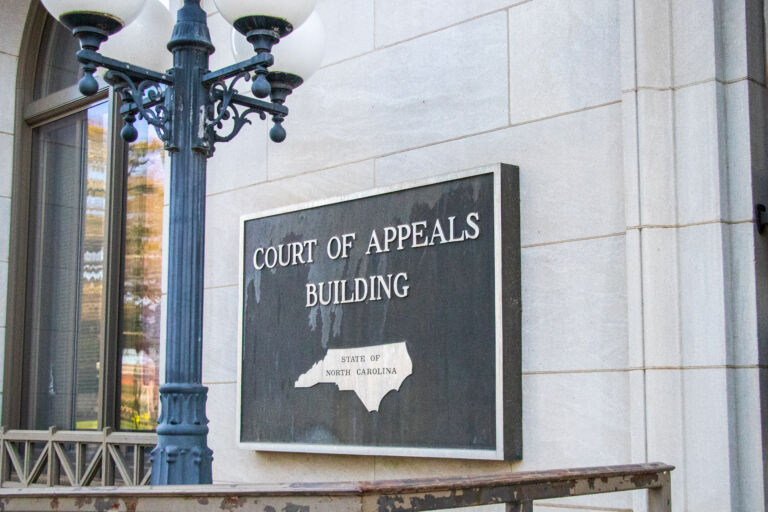
The North Carolina Court of Appeals will allow a Guilford County mother and son to move forward with their forced COVID vaccination claims against the local school board and a medical society.
The unanimous decision Wednesday arrived more than a year after the state Supreme Court overruled lower courts that had thrown out the lawsuit from Emily Happel and Tanner Smith.
Smith was 14 when he was forcibly vaccinated at a Guilford high school in 2021. Happel and Smith argued in court that a clinic worker from the Old North State Medical Society administered the COVID vaccine against the teen’s will and without parental consent.
Over Smith’s protests, the unnamed clinic worker is alleged to have said, “Give it to him anyway.”
Lower courts had ruled that the federal Public Readiness and Emergency Preparedness Act protected both the school system and the medical society from legal liability.
Yet the state Supreme Court’s 5-2 ruling in March 2025 revived the case. The high court allowed Happel and Smith to pursue a so-called Corum claim for violations of state constitutional rights.
Now the Appeals Court is sending the case back to a trial judge.
“This case returns on remand from the Supreme Court of North Carolina for our consideration of whether Plaintiffs’ complaint sufficiently alleges constitutional claims under the North Carolina Constitution,” Judge April Wood wrote for a unanimous three-judge appellate panel. “Specifically, our Supreme Court remanded two questions for our consideration: (1) ‘whether plaintiffs’ complaint sufficiently alleged that defendant [ONS Medical Society (‘ONSMS’)] was a state actor[;]’ and (2) ‘whether plaintiffs have an adequate state remedy available for their constitutional claims.’”
“After careful consideration, we conclude Plaintiffs sufficiently alleged state constitutional claims and remand this matter to the trial court for consideration of those claims,” Wood wrote.
“Here, Plaintiffs clearly allege that Guilford County Schools was a state actor and that ONSMS was working jointly with the state actor when its clinic worker allegedly forcibly vaccinated a minor against his expressed wish and without the consent of either the parent or the patient himself,” Wood explained.
“Although our Courts have not explicitly addressed whether private parties working jointly with the state qualify as ‘state actors’ for purposes of Corum claims, our Courts have consistently held that ‘a complaint should not be dismissed for insufficiency unless it appears to a certainty that plaintiff is entitled to no relief under any state of facts which could be proved in support of the claim. Pleadings are to be liberally construed,’” Wood continued.
“Because there are legal theories under which ONSMS could be viewed as a state actor such as ‘joint engagement’ used in § 1983 claims and the ‘totality of the circumstances’ used in fourth amendment claims, we hold Plaintiffs sufficiently alleged ONSMS was a state actor,” the Appeals Court opinion added.
The state Supreme Court had relied on the federal PREP Act to reject Happel and Smith’s battery claims, leaving them no other grounds for a lawsuit against the school system or medical society.
“Our Supreme Court has clearly stated that the federal PREP Act provides immunity to both entities and individuals against ‘any type of tortious injury: physical injury, property damage, loss of use, and so on,’” Wood wrote. “Thus, the PREP Act bars Plaintiffs’ battery claims, or any other tort claim, whether brought against a party in their official capacity or individually, completely foreclosing any opportunity to obtain relief apart from a Corum claim.”
“The PREP Act provides Plaintiffs with no remedy under state law that would serve as an alternative to the exceptional use of constitutional authority,” Wood added.
“A tort claim cannot stand as an ‘adequate remedy’ if PREP Act immunity ensures the plaintiff has neither the opportunity to enter the courthouse nor the possibility of relief,” she explained. “Therefore, we hold, under the facts of this case, Plaintiffs have no other ‘adequate state remedy’ for their alleged constitutional violations. Plaintiff’s complaint withstands the motion to dismiss.”
Now a trial judge “must determine whether, under the facts of this case, Defendants were ‘clothed with the authority of the State’ for the purposes of a Corum claim and if so whether any claim is meritorious,” Wood explained.
The case split the state Supreme Court along party lines last year.
“[W]e are tasked with considering whether Congress intended the PREP Act to immunize state actors who forcibly vaccinate a child without his or his parent’s consent, thereby committing a battery and infringing their fundamental rights under the state constitution,” wrote Chief Justice Paul Newby for the court’s Republican majority.
“The PREP Act’s plain text leads us to conclude that its immunity only covers tort injuries. Because tort injuries are not constitutional violations, the PREP Act does not bar plaintiffs’ constitutional claims,” Newby wrote.
“First, we agree that the state constitution protects a parent’s right to control her child’s upbringing, including her right to make medical decisions on her child’s behalf,” Newby wrote about the court’s support for Smith and Happel’s arguments.
“[T]he constitutional right to full ‘custody and control’ over one’s minor children would ring hollow if it did not include the right to consent on the child’s behalf, as well as the right to seek a constitutional remedy when the State disregards the absence of that consent,” Newby added. “Our state constitution and caselaw have long implied the existence of the precise right plaintiffs claim here. We directly recognize it today.”
The court’s majority identified another constitutional right tied to Smith and Happel’s suit. “[W]e agree that the Law of the Land Clause protects the right to bodily integrity, which we define as the right of a competent person to refuse forced, nonmandatory medical treatment,” Newby wrote.
“[T]he ambiguity of the PREP Act’s language requires us to consider whether Congress intended to include even unconstitutional conduct within the immunity’s broad scope,” according to the majority opinion. “Defendants ask us to adopt this literal reading.”
“Plaintiffs, on the other hand, contend that Congress could not have intended to immunize — indeed, even incentivize — unconstitutional conduct. We agree with plaintiffs,” Newby wrote.
“The literalist interpretation defendants urge us to adopt today defies even the broad scope of the statutory text. Under this view, Congress gave carte blanche to any willful misconduct related to the administration of a covered countermeasure, including the State’s deliberate violation of fundamental constitutional rights, so long as it fell short of causing ‘death or serious physical injury.’ … The ramifications of this approach are deeply repugnant to our constitutional traditions and the history of this State and Nation,” he added.
“We hold that the plain text of the PREP Act does not bar claims brought under our state constitution,” Newby wrote.
All five Republican justices supported Newby’s opinion. Justice Phil Berger Jr. wrote a separate concurring opinion supported by Justice Tamara Barringer.
“‘[F]orced medication [is] a battery, and the[re is a] long legal tradition protecting the decision to refuse unwanted medical treatment,’” Berger wrote, citing the 1997 precedent Washington v. Glucksberg. “That legal tradition is rooted in the Lockean notion of self-ownership – that bodily autonomy is the height of personal freedom and fundamental property rights, provided however that your actions do not harm others.”
“I write separately to note that the sweeping grant of immunity in the PREP Act seems contrary to this basic understanding,” Berger added. “The government’s reading of the Act appears to override state consent laws such that intentional torts may be cloaked with immunity when the harm inflicted falls short of death or serious physical injury. But shouldn’t immunity under the PREP Act be predicated on a lawful administration of a covered countermeasure?”
“Given the fundamental principles articulated by Locke and echoed in Glucksberg, it is difficult to concede that the PREP Act confers immunity for outright wrongful acts,” Berger concluded.
The high court’s two Democrats dissented from the decision in Happel v. Guilford County Board of Education.
“Self-described textualists and originalists have historically professed to avoid ‘turn[ing] somersaults’ to reach particular interpretations of the written law,” Justice Allison Riggs wrote. “The majority here should abandon any such pretense; through a series of dizzying inversions, it explicitly rewrites an unambiguous statute to exclude state constitutional claims from the broad and inclusive immunity ‘from suit and liability under Federal and State law with respect to all claims for loss’ established by the Public Readiness and Emergency Preparedness Act (PREP Act).”
“The majority also recognizes two implied fundamental state constitutional rights — one arbitrarily defined without any apparent principle — a right to bodily integrity divorced from bodily autonomy — and the other defined in principle but applied arbitrarily — the right of parents to direct the raising of their children,” Riggs added. “So, while I agree that the constitution protects rights to bodily integrity and those of parents to care for their children, I cannot concur in their articulation here. Because I find both the PREP Act and constitutional analyses fundamentally unsound, I respectfully dissent.”
“The facts alleged in the plaintiffs’ complaint are undoubtedly troubling; as even the defendants’ policies provided, the administration of a vaccine to a minor child without parental consent in these circumstances was wrong,” Riggs wrote. “The minor child and his parents had every right and reason to be outraged at their losses of their physical and parental rights. And, absent any congressional countermand, they should have the opportunity to pursue any lawful claims for those losses against those responsible.”
Language in the federal PREP Act is clear, Riggs wrote. “That this plain and unambiguous language leads to what a judge might view as undesirable policy outcomes — or even unforeseen ones — is no reason to disregard congressional intent; to the contrary, it reinforces our duty to apply it consistent with its broad reach.”
“After all, as the majority sees no irony in preaching, we are ‘a government of the people, not of the judges,’” she added.
“NC Appeals Court rules forced COVID vaccination case can proceed” was originally published on www.carolinajournal.com.


![[WBT107.9FM] app promo graphics 2025](https://wbt.com/wp-content/uploads/sites/84/2025/12/17653898024341.jpg?quality=80&strip=all&w=150&crop=0,0,100,150px)