UNC uses bridge funds for DEI-targeted research

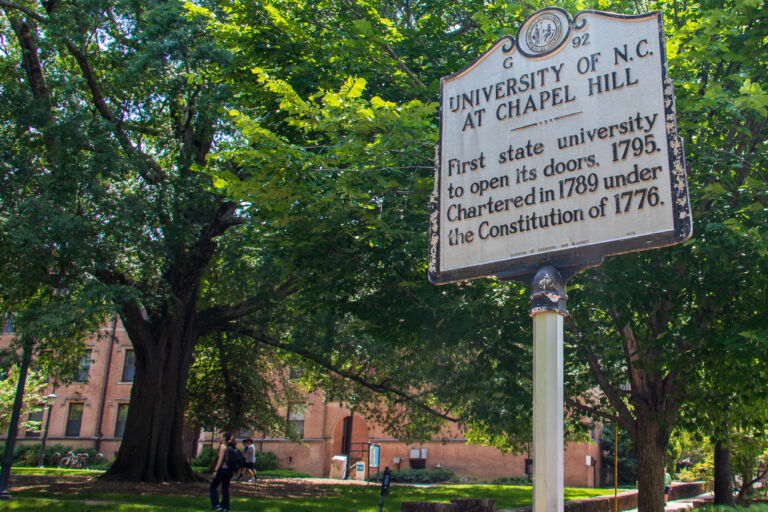
Shortly after Donald Trump returned to the White House, his administration moved to restrict National Institutes of Health-funded research that it views as related to diversity, equity, and inclusion (DEI). But at the University of North Carolina at Chapel Hill, several of these research projects live on through support from state taxpayers.
A Jan. 27, 2025 memorandum from the Office of Management and Budget placed grants related to “foreign aid, nongovernmental organizations, DEI, woke gender ideology, and the green new deal” on the chopping block. NIH Director Jay Bhattacharya and NIH Principal Deputy Director Matthew Memoli later elaborated in a December Spectator article that the agency would not fund projects that support “ideologies that promote differential treatment” based on race, ethnicity, or sexual orientation.
The federal ban, and a new UNC Board of Governors policy emphasizing free speech and nondiscrimination, have not ended research targeted by the Trump administration for promoting left-wing racial and gender ideology.
While awaiting court decisions on NIH funding, UNC-Chapel Hill employed a process known as bridge funding to cover some gaps left by federal cuts.
Faculty with research projects “that suffer a lapse in funding” can submit an application for bridge funding through the Office of Research in the School of Medicine, according to a March 13 memorandum from the UNC School of Medicine’s Office of Research. The university does not centrally track where this money goes, Jill Aronson Pfaendtner, director of Strategic Research Collaborations in the Office of the Vice Chancellor for Research (OVCR), explained in an email.
“These days the university itself doesn’t usually fund research directly,” Pfaendtner said. “Usually it is more indirect mechanisms — faculty startups, matching funds, etc.”
Supplemental funding decision information is only held in local departments, as there is no “central mechanism to track expenses,” she noted.
“Bridge funding is not overseen or managed by a single entity and does not have system or university level guidelines for how each unit may choose to fund or handle requests,” a university spokesperson replied in an email.
SOM-Bridge-Funding-May-2026Download
Covering these funding gaps is permitted under North Carolina law and UNC System policy, a university spokesperson wrote. In 2024, the UNC System Board of Governors policy cracked down on DEI initiatives within the university system.
The “Equality within the University of North Carolina” policy led UNC-Chapel Hill to eliminate 20 DEI-focused positions ahead of the 2024-25 school year, the university announced. However, according to a UNC statement released in 2024 about compliance, the university policy does not apply to research, only student life and hiring.
“UNC-Chapel Hill faculty have academic freedom, which includes the freedom to pursue research projects within their field of study,” a university spokesperson wrote.
“Once [the money] is in the University of North Carolina system, it is now a public dollar,” said Jay Greene, director of research at Do No Harm, a conservative think tank focused on health care policy.
Any UNC-held cash is public money and accountable to voters, who Greene says have a right to know how that funding is used.
“Just because it comes from a [internal] pot of money doesn’t mean it’s not public money,” Greene added.
Officials in the School of Medicine did not respond to a request for comment on whether bridge funding comes from the North Carolina legislature, UNC tuition, or external sources, or if bridge funding has already been used to sustain research programs described by the federal government as DEI.
“The University ensures compliance with federal nondiscrimination rules, including Title VI, through a comprehensive approach that includes trainings, outreach and policies,” a university spokesperson replied.
The NIH is the largest funder of biomedical research projects in the US, according to its website. A Blue Ridge Institute for Medical Research ranking shows that the UNC School of Medicine received $353 million in federal funding in 2025, making it the sixth-largest recipient of NIH funding among public universities, and 18th-largest recipient overall.
One NIH-funded study examining transgender-specific HIV prevention and care was reinstated following an American Civil Liberties Union lawsuit challenging the grant terminations, according to Dr. Audrey Pettifor, UNC professor of epidemiology and project principal investigator (PI). The study, conducted by UNC affiliates through Duke University School of Nursing, is one component of an eight-part project that received $2,632,001 in federal funding, according to the NIH portal.
Although UNC-Chapel Hill did not take part in these lawsuits, some programs have had funding restored as a result.
“I was fortunate in that a number of our big grants came back,” said Pettifor, who also currently serves as PI for a UNC study on the effect of cash transfers on rural South African adolescent girls’ mental health, which was awarded $480,536 in 2026 alone.
Another project drew $576,352 in 2026 to investigate breast reconstruction disparities in black and Latina populations. This program, which includes a social media-deployed survey, has been awarded $1,788,927 since its inception.
UNC has provided advice to researchers in a bid to maintain their projects. In response to a January 2025 memo which sought to eliminate DEI programs in the federal government, the OVCR advised “research teams to continue working on your projects as normal” until given further guidance. Days later, an OVCR update on the executive orders emphasized that the university already prohibits “differential treatment on the basis of race or sex,” but provided no order for researchers to halt DEI-related projects. The update claimed that “the University has engaged in various efforts to ensure compliance with recently revised Systemwide policies.”
In an early February 2025 OVCR update for those who lost federal funds, The CFO of the University “pledged to provide some limited backstop funding in situations to ensure stability.” OVCR later reiterated the position in a February 2025 Office Hours update, mentioning “temporary bridge funding programs” that could support researchers. The directives do not explain how this funding would apply to DEI-advancing research. OVCR also advised researchers in the aforementioned update that they are not required to change their DEI-related projects, but to keep in mind that their projects must remain competitive in future grant cycles.
Current and proposed state laws do not appear to affect research involving race, sex, sexual orientation, or related disparities. H 171, which was vetoed by the governor, has since cleared the North Carolina Senate through a veto override and is now before the House, where a successful vote would complete the override. The bill would prohibit any “program, policy, initiative, or activity” that “promote[s] differential treatment” or “provid[es] special benefits to individuals on the basis of race, sex, color, ethnicity, nationality, country of origin, or sexual orientation.” But it includes carve-outs for “academic course instruction” and for “scholarly research or a creative work by an institution of higher education’s students, faculty, or other research personnel or the dissemination of that research or work.”
No UNC Board of Trustees members responded to a request for comment on efforts to recenter research culture away from DEI.
Greene supports greater oversight of university research funding and said such limits can be consistent with academic freedom.
“Academic freedom doesn’t mean I get to do whatever I want,” Greene said. “Academic freedom means that I am allowed to answer questions in scholarly publications within my field of expertise in an honest way. And it also doesn’t mean that you are entitled to funding, to money, to pursue those questions. It doesn’t mean you get to choose how money is spent.”
“UNC uses bridge funds for DEI-targeted research” was originally published on www.carolinajournal.com.


![[WBT107.9FM] app promo graphics 2025](https://wbt.com/wp-content/uploads/sites/84/2025/12/17653898024341.jpg?quality=80&strip=all&w=150&crop=0,0,100,150px)