Clash over Orange Co. school impact fees returns to Appeals Court
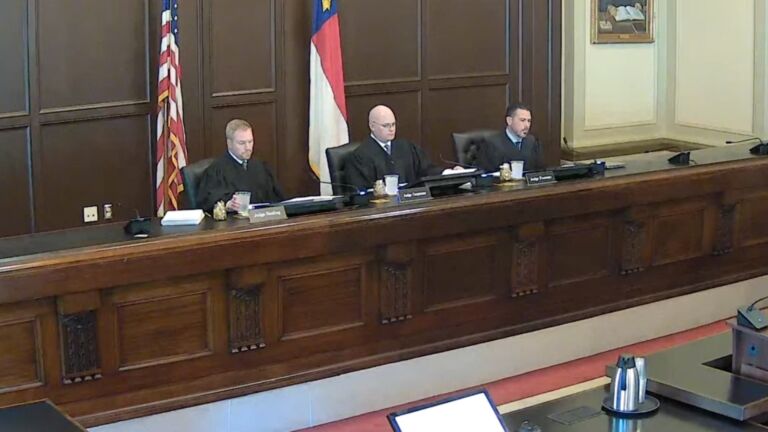
A nine-year legal battle over Orange County school impact fees returned Tuesday to North Carolina’s second-highest court. Critics urged that court to reverse a trial judge’s decisions that led to a 2025 jury verdict favoring the county and Chapel Hill.
The state Supreme Court ruled in December 2024 that plaintiffs Elizabeth Zander and Evan Galloway could move forward with the class-action suit filed in 2017. That decision reversed rulings from a trial judge and the state Appeals Court.
But Zander and Galloway lost their case in a jury trial last year. Now the case is back before the North Carolina Court of Appeals.
“The county commissioners took millions of dollars from families and businesses with no plan or demonstrated need to use that money for the schools,” lawyer Robert King argued Tuesday at the Appeals Court on behalf of Zander and Galloway.

The state law permitting impact fees called for the county to use a “plan first, tax second approach,” King argued. County commissioners needed to demonstrate a need for new schools before charging impact fees, he said.
“It appeared from what we could see that the county simply ignored what the General Assembly had said and what the county said [was], ‘You know what? We’re going to tax first. We’ll figure out what we’re going to do with the money later,’” King added.
The original impact fee was $750. “Fifteen years later, it had gone up 1,200%,” King argued. Galloway paid $11,423 for one home.
“That money is gone,” he said. “It wasn’t used on the schools. The county can’t tell us where it went.”
Orange County followed the law, using a 10-year planning period to calculate the need for impact fee money, countered lawyer Sonny Haynes.
“There was simply no evidence at all that contradicted the county’s position,” Haynes said.

Haynes defended Superior Court Judge Allen Baddour’s decision that the plaintiffs had failed to provide enough evidence to submit one of its chief claims to a jury.
“Not even a scintilla?” asked Appeals Court Judge Jeff Carpenter.
“Not even a scintilla, your honor, there was nothing,” Haynes responded.
Carpenter and fellow Judges Chris Freeman and Michael Stading will decide the case.
Stading wrote a 2023 dissent that the state Supreme Court adopted as its opinion favoring Zander and Galloway.
“The law means whatever the Supreme Court says it means,” Carpenter reminded Haynes.
The plaintiffs argued in a February brief that Baddour mishandled the case.
“Between 2009 and 2016, Defendants Orange County and Chapel Hill extracted millions of dollars in unlawful ‘school impact fees’ from homebuilders and residents of Orange County,” the plaintiffs’ lawyers wrote. Zander and Galloway represent a feepayer class, which seeks the “recovery” of illegal fees, and a refund class that seeks refunds mandated by county ordinances, according to the brief.
The state Supreme Court’s 2024 decision called for a trial addressing two issues, the plaintiffs argued.
“First, did the County estimate the costs of improvements ‘to be made’ ‘within a specific period of time’ when calculating the impact fees collected from the Feepayer Class?” according to the brief. “Second, did the County decide to reduce impact fees in 2016 ‘due to reasons other than an update impact school fee study’?”
“Despite the straightforward appellate mandate,” Baddour did not allow a jury to address the second issue, the plaintiffs’ lawyers wrote. That action contradicted the Supreme Court’s ruling, according to the brief.
The first issue “was also mishandled,” the plaintiffs’ lawyers argued. “In fact, the undisputed evidence shows that judgment should have been entered for Plaintiffs and, as a result, this Court should reverse the trial court and enter judgment for Plaintiffs.”
“In the alternative, a new trial is necessary because the trial court erred by repeatedly refusing to apply the law of the case regarding the Feepayer Class issue, erroneously instructing the jury regarding the Supreme Court’s mandate, admitting legal opinion testimony over Plaintiffs’ objection, and ultimately denying Plaintiffs a fair trial,” according to the brief.
Lawyers representing Orange County and Chapel Hill responded in March.
“This appeal asks this Court to set aside a unanimous jury verdict returned after a full and fair trial, and second-guess a trial court’s directed verdict ruling grounded in the insufficiency of Plaintiffs-Appellants’ own evidence,” the local governments’ lawyers wrote. “Neither request is warranted.”
“A unanimous jury found Zander had not met the burden of proving the County failed to comply with the Enabling Act’s requirements to estimate the total cost of school capital improvements that would be needed during a reasonable planning period not to exceed twenty years,” the brief added. “That verdict reflected the ‘commonsense judgment of the community.’ and was consistent with the ‘fundamental right to trial by jury in civil cases which is guaranteed by our Constitution.’”
“Zander now asks this Court to do what North Carolina law does not permit: reweigh the evidence a jury already considered, override the trial court’s sound discretion on evidentiary and instructional matters, and convert a remand for trial into a remand for entry of judgment in Zander’s favor,” local government lawyers continued. “The mandate rule does not compel such an extraordinary result.”
“The Supreme Court remanded this case for ‘further proceedings,’ i.e., a trial, not for entry of judgment for Zander,” the brief explained. “The trial court faithfully discharged that mandate. It submitted the Feepayer Class issue to the jury, and the jury resolved it against Zander. It evaluated the Refund Class evidence under the directed verdict standard and correctly concluded that Zander’s proof was legally insufficient to support a jury verdict. These rulings were well within the trial court’s authority and discretion and should be affirmed.”
The state Supreme Court’s December 2024 decision had reversed a split Court of Appeals. The Appeals Court’s 2023 decision delivered a less clear-cut result in 2023 for plaintiffs challenging the impact fees.
In an unsigned two-page opinion, the state Supreme Court voted 5-1 to support Appeals Court Judge Michael Stading’s 2023 dissent. Stading would have allowed impact fee opponents to pursue their claim that the fees are unlawful. Stading and the five-justice Supreme Court majority are Republicans.
Justice Allison Riggs, a Democrat, took no part in the Supreme Court’s decision. She had written the majority opinion when the Appeals Court issued its ruling in July 2023.
Justice Anita Earls, also a Democrat, wrote a two-sentence Supreme Court dissent endorsing Riggs’ Appeals Court decision.
Critics challenging Orange County’s school impact fees offered their written arguments to North Carolina’s highest court in May 2024. It was the latest step in a class-action legal dispute that started in 2017.
“Between 2009 and 2016, Orange County (the ‘County’) illegally extracted millions of dollars in unlawful ‘school impact fees’ from homebuilders and residents of Orange County,” wrote lawyers representing the plaintiffs. “In doing so, the County did not simply act illegally but did the opposite of what the General Assembly intended.”
“Such fees were putatively for the benefit of the County’s two school systems, but even the County does not know how the money was spent,” the plaintiffs’ brief continued. “The County also refused to comply with its own ordinance: The County committed that it would return certain monies to the people who had paid such amounts under certain circumstances. Just as the County ignored the directives of the General Assembly, it ignored its own ordinance.”
“In both situations, the law is clear and the facts are undisputed,” the plaintiffs’ lawyers argued. “Plaintiffs represent two certified classes: the ‘Feepayer Class,’ which seeks the recovery of the illegally-imposed ultra vires impact fees, and the ‘Refund Class,’ which seeks the recovery of mandatory refunds.”
The state Supreme Court already ruled in 2020 that the case could proceed as a class-action suit.
“The Feepayer Class consists of a group of residents, developers, and homebuilders who were forced to pay the County’s impact fees as a condition of obtaining certificates of occupancy for new homes,” according to the plaintiffs’ brief. “The question raised here by the Feepayer Class is simple: Did the County comply with the mandate of the General Assembly in calculating the impact fees? If the answer is no — and it plainly is — then the County’s collection of fees was ultra vires, and the fees must be returned to those who paid them, with interest.”
“The Refund Class seeks partial refunds of fees that Orange County promised to make in its own ordinance. Just as the County ignored requirements of the Enabling Act, the County refused to comply with its own ordinance. The Refund Class is entitled to payment of those refunds, plus interest,” the court filing added.
The Court of Appeals ruled in July 2023 that Orange County might have to refund some challenged school impact fees. The decision offered a potential partial victory to the plaintiffs.
The decision in Zander v. Orange County prompted a 2-1 split on the appellate panel. The dissenting judge, Stading, would have issued a ruling even more favorable to plaintiffs challenging the county’s actions. A trial judge ruled against the plaintiffs in 2022.
“After careful review, we agree that the County unlawfully included some costs not authorized by statute in calculating the impact fees and hold that the Feepayer Class is entitled to recoup the portion of the school impact fees that were assessed to cover those improper costs,” Riggs wrote for the Appeals Court majority. “However, because the evidence does not establish the amount of impact fees attributable to these impermissible costs, we remand the matter for further proceedings to determine the damages owed to the Feepayer Class.”
“As to the Refund Class, we hold that the trial court properly granted summary judgment for the County because the forecast of evidence demonstrates that no refunds are owed under the applicable ordinance,” Riggs added.
Riggs and Judge Fred Gore agreed that the county could not charge impact fees to recover costs for new school buses or for the consultant who compiled impact fee studies. “[T]hey are not themselves ‘capital improvements’ as the word is ordinarily understood,” Riggs wrote. “A bus and a consultant’s report simply are not ‘acqui[sitions] [of] or improve[ments] [to] a fixed asset.’”
“The County’s arguments to the contrary are unpersuasive,” she added.
Yet it’s unclear whether the Appeals Court decision would have led to actual refunds. “Though we hold that the County could not include buses and … consultant fees in calculating school impact fees, this does not fully resolve Plaintiffs’ claims on behalf of the Feepayer Class,” Riggs explained. “As noted in its brief, the County never set its impact fees at 100% of the maximum amounts calculated, … electing instead to impose fees ranging between 32% and 60% of that maximum amount at various times. The County thus may have calculated and assessed impact fees that did not incorporate or cover anticipated bus and consultant costs.”
The Appeals Court ordered the case sent back to a trial judge to address potential refunds.
“The statute at issue is designed to make plaintiffs whole for illegal fees only; nothing in the statute suggests it is intended to punish local governments while granting a windfall to plaintiffs,” Riggs wrote.
Stading would have reversed the trial judge’s entire order favoring Orange County. Claims from both the “feepayer” and “refund” classes would have moved forward in a trial court. The Supreme Court majority endorsed Stading’s opinion.
“Substantial evidence shows that when Orange County calculated the taxes at issue, it neglected to follow the protocol outlined and mandated by the General Assembly in the Session Law,” Stading wrote. “While I agree with the majority that impact fees should not have been expended on buses and consultant studies, I am nevertheless precluded from reaching consideration of impermissible costs because a jury should resolve the lawfulness of the impact fees as a preliminary matter.”
“Similarly, there is a genuine issue of material fact to be resolved with respect to the contradictory evidence of underlying reasons for a reduction in impact fees,” he added.
The dissenting judge noted evidence that consultants calculating the fees did not use a planning period required by law.
“Since there is a genuine dispute of material fact as to whether the County used a planning period, the impact fees may have been ultra vires,” he wrote.
Stading also cited evidence that bolstered the “refund” class’s arguments. If impact fees were altered for reasons other than an updated impact fee study, the legal case should have moved forward.
“The County’s own … witness cited concerns of ‘timing’ and ‘the nature of the General Assembly,’” the judge wrote. “Thus, there is a genuine issue of material fact as to whether the County complied with the refund provision required by its Ordinance as amended in 2016.”
“Clash over Orange Co. school impact fees returns to Appeals Court” was originally published on www.carolinajournal.com.

![[WBT107.9FM] app promo graphics 2025](https://wbt.com/wp-content/uploads/sites/84/2025/12/17653898024341.jpg?quality=80&strip=all&w=150&crop=0,0,100,150px)