Helene debris raises wildfire fears

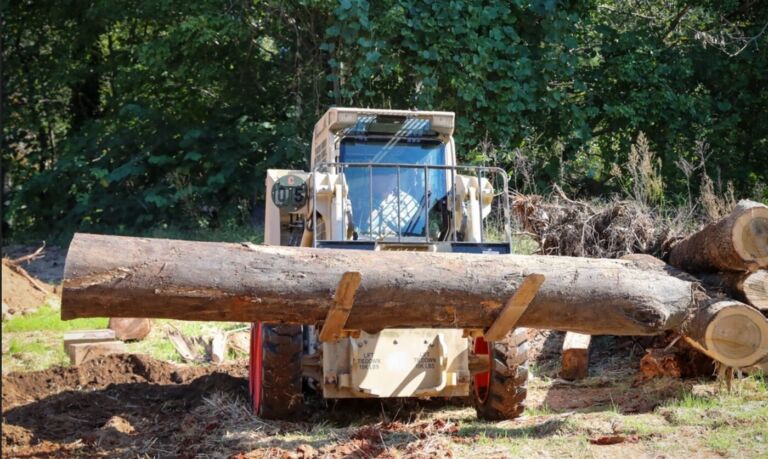
Western North Carolina recovery officials are warning that Hurricane Helene left behind more than flood damage and destroyed infrastructure. Across the mountains, hundreds of thousands of acres of downed timber are now creating what state forestry leaders describe as a long-term wildfire threat that could linger for more than a decade.
During recent GROW NC recovery meetings, state officials and economic planners described a region struggling with dangerous fuel loads, weakened timber markets and mounting pressure on workforce and housing systems needed to support long-term recovery.
State forestry officials estimate Helene damaged roughly 822,000 acres of forestland across 25 western North Carolina counties. About 75% of the damaged land is privately or state-owned. Officials also estimated approximately 616,000 structures sit within damaged forest areas.
“The red and the dark red, that is heavy blowdown, high-damage areas,” North Carolina Forest Service Regional Forester Michael Cheek said while presenting wildfire maps to recovery leaders.
Forestry officials warned the danger is not simply the number of fallen trees, but the way storm debris is stacked across steep mountain terrain. Large hardwood trees remain suspended off the ground, drying slowly and creating hotter fires.
“That stacked form helps add to the intensity of that fire,” Jonathan McCall, southern mountains forest manager with the North Carolina Wildlife Resources Commission, told the committee.
McCall said wildfire response is becoming more difficult because old roads and firebreaks are now buried under debris.
“It greatly increases the time that it takes for us to build those lines,” he said.
Officials warned that some damaged areas may remain hazardous for 10 to 20 years before the timber naturally decays enough to reduce fire risks.
The wildfire discussion built on the other recent subcommittee conversation about western North Carolina’s economy and whether the region has enough private-sector capacity to handle the scale of cleanup now required.
Officials repeatedly pointed to the closure of regional mills — including the Canton paper mill — as a major obstacle.
Before Helene, western North Carolina’s timber economy was already shrinking due to aging logging operators, mill closures and declining markets for low-grade wood products. Helene flooded the market with damaged timber while reducing the region’s ability to process it.
“There is a tremendous amount of wood out there and available,” Cheek said.
Officials acknowledged that much of the timber may never be salvaged economically.
“Even if we’re giving away salvage, we’re not able to get the sales the way we’d like to see,” McCall said.
The discussions highlighted how wildfire mitigation now depends partly on rebuilding functioning timber markets capable of removing fuel from forests before future disasters strike.
Recovery leaders discussed possible market-based solutions, including biomass processing, wood pellets and biochar manufacturing using storm debris. Officials described forestry and biomass industries as possible economic growth sectors for western North Carolina if private investment can be attracted to the region.
At the same time, economic development subcommittees warned the region faces broader structural challenges beyond wildfire recovery.
“There’s just extraordinary assets that we can build upon around economic development and entrepreneurship,” one participant said during the economic development discussion.
Committee members discussed strengthening manufacturing corridors, expanding startup investment and connecting small businesses to larger regional supply chains.
But workforce shortages and housing costs repeatedly emerged as major concerns.
“If you can’t live here, you can’t work here,” subcommittee co-chair Laura Leatherwood said during the workforce discussion. She is the president of Blue Ridge Community College.
The comments came on the same day as Gov. Josh Stein issued an executive order on housing and announced a housing policy advisor.
Officials said rising housing costs are making it harder for businesses to recruit workers across tourism, manufacturing and service industries. Workforce development discussions also focused heavily on apprenticeship programs, community colleges and STEM education pipelines.
Infrastructure concerns also surfaced repeatedly throughout the meetings.
Participants referenced an upcoming statewide economic development plan from the North Carolina Department of Commerce that places major emphasis on infrastructure investment. Gov. Stein announced the “First in Opportunity” plan on May 27.
But several discussions focused less on large public projects and more on smaller “catalytic” infrastructure improvements that could strengthen local economies and workforce systems.
Tourism and arts leaders also warned that recovery efforts must balance economic growth with protecting the character of mountain communities.
“Helene debris raises wildfire fears” was originally published on www.carolinajournal.com.


![[WBT107.9FM] app promo graphics 2025](https://wbt.com/wp-content/uploads/sites/84/2025/12/17653898024341.jpg?quality=80&strip=all&w=150&crop=0,0,100,150px)