Should overpass protesting be prohibited? Legal analysts weigh in.
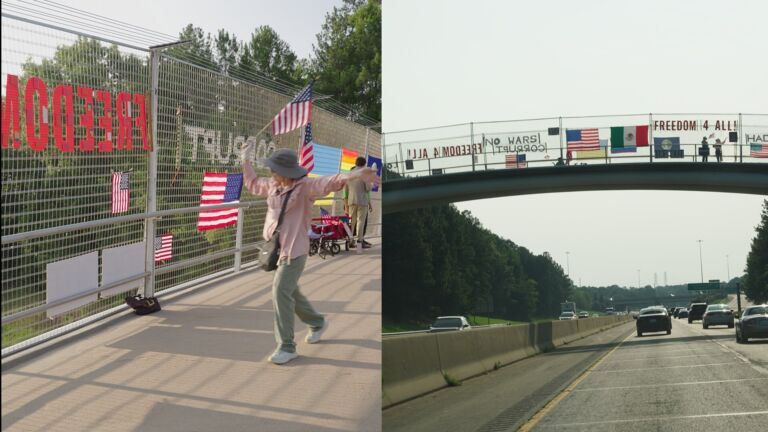
When Carolina Journal analyzed crash data surrounding recurring protests on a pedestrian bridge over Interstate 40 in Durham, the findings raised serious public-safety concerns.
Rear end collisions occurred more frequently, increasing by 157% during the demonstrations, according to Carolina Journal’s analysis, while motorists and traffic-safety experts described how signs, flags, and activity above a busy interstate could distract drivers traveling at highway speeds. Demonstrators acknowledged that passing motorists regularly honked, waved, or otherwise reacted to the protests.
“We had one instance about a month ago where a man in a white pickup truck was looking up at us giving us the middle finder and slammed into the car in front of him and caused a huge backup in traffic that went back for miles,” said one bridge protestor.
But a similar review of demonstrations on a pedestrian bridge in Mauldin, South Carolina, produced a very different result.
A Carolina Journal analysis found no measurable increase in collisions during either “No Kings” demonstrations or pro-life protests regularly held on the Gateway Bridge overlooking Interstate 385. Despite the absence of a detectable increase in crashes, Mauldin police began enforcing new restrictions on demonstrations along bridges and trails in May, citing concerns about public safety.
This disparity raises questions about the extent to which states and counties can, and should, put restrictions on overpass protesting.
Content based vs content neutral
Jon Guze, the senior fellow for legal studies at the John Locke Foundation, proposed the idea of a content neutral restriction on overpass protesting following the Carolina Journal analysis of the I-40 bridge protests.
“A complete ban on highway overpass protests would be content neutral, protecting traffic safety is clearly a significant governmental interest, and there are plenty of alternative places these protestors could go,” said Guze.
A letter from the Thomas More Society was submitted by the pro-life group to Mauldin police, defending the group’s right to protest on the Gateway bridge. However, Guze said that the letter made no argument against content neutral restrictions on overpass protesting, like those enacted in Mauldin.
“Their complaint is that they were being singled out because of the content of their speech, specifically,” said Guze. “Thats just not relevant to the discussion we are having about banning overpass protesting.”
“If you go to the case that was cited by the Thomas More Society in their letter, it [cites] Supreme Court precedent that states that you can regulate speech so long as its content neutral,” he added.
However, content neutral restrictions can still only be put in place if a “significant government interest” can be demonstrated. Jeanette Doran, the Beverly Lake, Jr. chair of Constitutional Studies at the John Locke Foundation, believes that the statistical rise in collisions on I-40 and reports of chaos from drivers and protestors is a clear basis for this interest.
“I think your reporting and the data that shows a 157% increase in [rear end] accidents during the protest times is exactly the type of metric that law enforcement should be looking at to consider enforcement,” said Doran. “[the general assembly] should consider general content neutral bans on overpass protesting. Those would almost certainly survive any First Amendment scrutiny.”
Are protests and billboards equivalent?
The Engaged Defenders 4 Democracy, the local group that organizes the I-40 bridge protests, has consistently claimed that their demonstrations are protected by the First Amendment, specifically, comparing their protests to billboards.
However, Guze dismissed this defense.
“That is a very silly comparison and a very foolish one for them to make,” said Guze. “Billboards all occur on private property. I don’t think they are allowed on right-of-ways, and certainly not overpasses, anywhere in the state.”
“More importantly, there are lots of restrictions on what can be on a billboard,” added Guze. “The General Assembly passed an act years ago that allows for the regulation of billboards, and the Department of Transportation has regulated billboards in ways that prohibit flashing and moving lights or scrolling displays. I don’t think you would be able to have a video of these protests on a billboard anywhere near a highway in North Carolina.”
“Should overpass protesting be prohibited? Legal analysts weigh in.” was originally published on www.carolinajournal.com.

![[WBT107.9FM] app promo graphics 2025](https://wbt.com/wp-content/uploads/sites/84/2025/12/17653898024341.jpg?quality=80&strip=all&w=150&crop=0,0,100,150px)