New federal housing law targets NC’s supply shortage
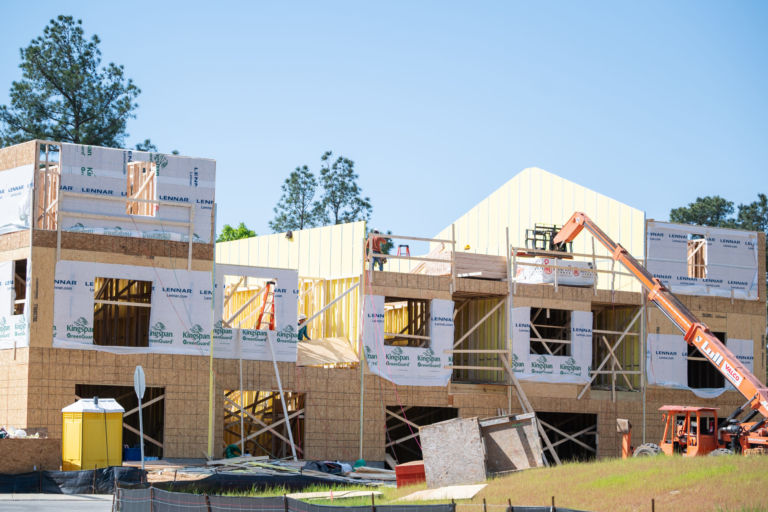
A sweeping new federal housing law aims to chip away at North Carolina’s projected shortage of more than 764,000 homes by encouraging local construction, expanding financing and manufactured housing options, and restricting large institutional investors from purchasing additional single-family properties.
The 21st Century ROAD to Housing Act became law on July 11 after passing Congress with broad bipartisan support. The Senate passed the measure 85-5, and the House passed the measure 358-32.
The law represents the broadest federal attempt in decades to address housing affordability by expanding supply rather than relying primarily on subsidies for buyers and renters.
“Instead of piling on new mandates or subsidies, the 21st Century ROAD to Housing Act removes the barriers standing between American families and an affordable home,” U.S. Rep. Tim Moore, R-NC14, said in a statement following the bill’s passage.
That law could carry particular significance in North Carolina, where the shortage of available homes extends across urban, suburban, and rural communities.
A statewide housing needs assessment conducted by the NC Chamber of Commerce estimates that North Carolina faces a five-year inventory gap of 764,478 homes.
The shortage is particularly severe for prospective homeowners. North Carolina’s for-sale availability rate stands at 0.8%, well below the 2% to 3% range generally associated with a healthy market.
The assessment estimates that closing the state’s rental and for-sale housing gaps could generate $489 billion in economic activity and support nearly 2.2 million jobs.
Kelly Lester, a policy analyst at the John Locke Foundation’s Center for Food, Power, and Life, argues that restrictive zoning, permitting delays, parking mandates, minimum lot sizes, and other regulations have prevented construction from keeping pace with demand.
“Housing markets function best when supply can respond to demand,” Lester said. “Unfortunately, that has not been the case. In many communities, local governments have made it extraordinarily difficult to build new homes, thanks to exclusionary zoning ordinances, lengthy approval processes, excessive permitting requirements, and other restrictions. These policies artificially limit supply, reduce competition, and drive up prices.”
Encouraging local housing reform
The federal law seeks to encourage local governments to remove some of those barriers through financial incentives rather than federal zoning mandates.
It directs the US Department of Housing and Urban Development to establish a competitive grant program for communities that demonstrate measurable increases in housing supply. Policies that could help communities qualify include allowing duplexes and multifamily buildings by right, reducing parking requirements, permitting accessory dwelling units, shortening approval timelines, and revising minimum lot sizes.
Congress authorized up to $200 million annually for the program from fiscal years 2027 through 2031.
The law explicitly prevents HUD from overriding local zoning policies. It also does not reward communities merely for adopting a particular reform. Local governments would have to demonstrate that policy changes resulted in additional housing construction before receiving a grant.
Lester said that the balance between encouraging more construction and preserving local control is critical.
“A federal program designed in Washington may not always reflect the needs of communities in North Carolina’s mountains, coast, and rapidly growing metropolitan areas,” Lester added. “Local governments should have flexibility to determine what works best for their residents rather than relying solely on federal solutions.”
HOME Expansion Act
The law also incorporates US Sen. Ted Budd’s HOME Expansion Act, which broadens access to assistance provided through the federal HOME Investment Partnerships Program.
The program provides money to states and local governments for affordable housing construction, home rehabilitation, and assistance for prospective buyers. The new law raises the household income limit for certain assistance to 100% of an area’s median family income and increases the maximum eligible home purchase price from 95% to 110% of the area’s median purchase price.
Budd’s office estimates that the change would raise the purchase price limit for HOME down payment assistance in the Charlotte metropolitan area from about $390,000 to $451,500.
“First-time homebuyers are often at a disadvantage as they juggle the associated costs of purchasing a home, while still responsible for monthly rent,” Budd said in a statement after the bill’s passage. “At a time when demand for homes is increasing, and the available supply is short, I am proud that my HOME Expansion Act is now law so that we can help more families afford their first home by expanding eligibility to existing homebuyer assistance programs.”
Institutional investors restrictions
Another prominent provision responds to growing public concern about large institutional investors competing with families for a limited supply of homes.
An April national poll conducted for the Bipartisan Policy Center found that 70% of registered voters supported prohibiting corporations and investment funds owning at least 350 single-family homes from purchasing additional properties. Only 12% opposed the policy.
The prohibition applies to for-profit entities that directly or indirectly control at least 350 single-family homes. Those investors will generally be barred from purchasing additional properties for 15 years.
The measure is intended to give prospective homeowners more opportunities to compete for available properties, particularly in fast-growing markets where buyers may face cash offers from corporate investors.
Institutional investors own about 1.8% of North Carolina’s single-family homes, according to data from the American Enterprise Institute.
Critics of the restriction argue that institutional investors do more than compete for existing homes. Edward Pinto, co-director of the American Enterprise Institute’s Housing Center, wrote in a RealClearMarkets op-ed, that they also provide the necessary capital needed to spark supply growth.
“Institutional investors aren’t just buyers; they are capital providers and builders,” Pinto said. “In cities that permit growth, their presence is linked to higher permitting and more family-sized homes. They also add to the housing supply by rehabilitating vacant homes. Operating at scale with lower costs enables them to rehab tired housing stock. Finally, they partner with homebuilders to create new neighborhoods of single-family rental homes.”
The law does not require institutional investors to sell homes they already own. It also includes exceptions for newly constructed build-to-rent communities, substantially renovated homes, certain foreclosure-related purchases, senior housing, and programs intended to help renters become homeowners.
Streamlining hurricane housing recovery
The legislation could also affect how western North Carolina recovers from future hurricanes and other catastrophic disasters.
The law creates a new framework for the Community Development Block Grant Disaster Recovery program, which provides flexible, long-term assistance following major disasters.
Unlike Federal Emergency Management Agency aid, which is generally directed toward immediate response and specific eligible losses, CDBG-DR funding can address remaining housing, infrastructure, and economic-recovery needs after insurance and other assistance have been exhausted.
North Carolina received a $1.4 billion CDBG-DR allocation, with most of the money directed toward repairing and rebuilding homes for low- and moderate-income residents after Hurricane Helene.
That money was not immediately available, however. Congress first had to approve a broader disaster appropriation. HUD announced North Carolina’s allocation in January 2025, after which the state had to assess its unmet needs, develop an action plan, and obtain federal approval.
North Carolina submitted its plan in March, 2025, and HUD approved it in April, nearly seven months after the storm.
The new law attempts to make that process more predictable by establishing a Long-Term Disaster Recovery Fund. From the fund, the department would provide grants of up to $5 million to state and local governments to assess unmet housing needs, prepare recovery plans, and identify vulnerable and displaced residents before a disaster occurs.
“New federal housing law targets NC’s supply shortage” was originally published on www.carolinajournal.com.

![[WBT107.9FM] app promo graphics 2025](https://wbt.com/wp-content/uploads/sites/84/2025/12/17653898024341.jpg?quality=80&strip=all&w=150&crop=0,0,100,150px)