Audit: 78% of NC inactive landfills not monitored

Out of 688 pre-regulatory inactive landfill sites in North Carolina, 534 (78%) are not being actively monitored through the North Carolina’s Department of Environmental Quality’s (DEQ) Division of Waste Management’s (DWM) Pre-Regulatory Landfill Program. That’s according to a performance audit released on Monday by the North Carolina Office of the State Auditor.
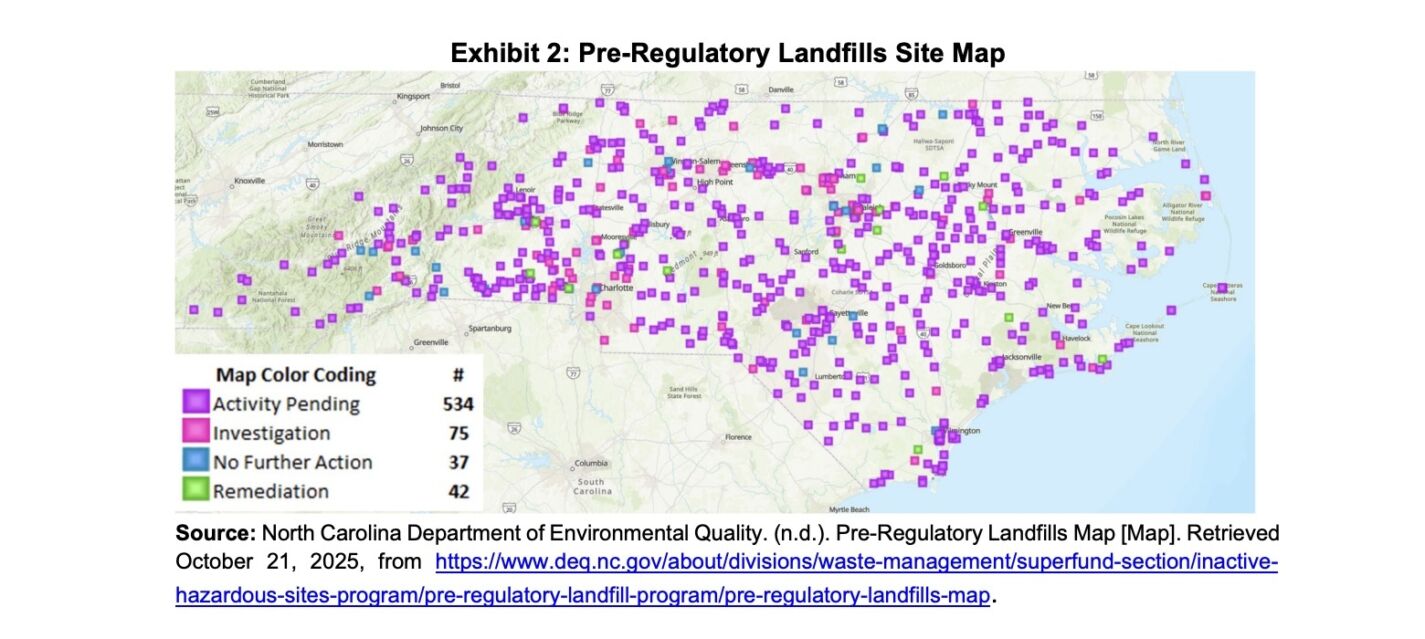
The audit states that figure is as of June 30, 2025.
The program was started in 2007 to identify, assess, and remediate sites that accepted a wide range of waste types without regulatory oversight prior to Jan. 1, 1983.
State law requires DEQ to develop a program for “locating, cataloguing, and monitoring all inactive hazardous substance or waste disposal sites in North Carolina.”
The former landfills may contain hazardous, medical, or asbestos-containing materials, as well as elevated levels of landfill gases such as methane. In addition, there may be contamination of groundwater, surface water, soil, and sediment, all of which can pose significant risks to public health and the environment
The report said approximately 84% of sites are located within 1,000 feet of homes, schools, day cares, churches, or potable water wells, creating ongoing and largely unknown risks to public health and the environment.
The type of contamination at most of the sites is still not known according to the audit, or whether it has spread to nearby properties or water supplies, or whether current conditions pose a risk to nearby residents.
Auditors say where investigations have occurred, they have identified serious hazards, including elevated methane levels, contaminated soil, and polluted groundwater.
“The Pre-Regulatory Landfill Program is a complex issue that creates challenges from a regulatory, legal, funding, and administrative standpoint,” State Auditor Dave Boliek said in a press release. “But the bottom line is there are hundreds of potentially hazardous landfill sites across North Carolina, and despite tax dollars supporting a program meant to investigate these sites, 78% haven’t been examined. This audit lays out the facts, giving taxpayers a reliable update on a longstanding government issue.”
Limited progress in monitoring and remediation of the sites is due to restricted access to privately owned properties, which account for about 78% of the sites, and resource constraints, according to auditors.
Program management estimates the average cost to investigate, assess, and remediate a site is approximately $1.9 million, and would cost a total of $1 billion if applied to the remaining sites.
Even though the program receives funding from the state Solid Waste Disposal Tax, available resources only supportive to six sites per year. At that rate, it would take approximately 99 years to remediate the remaining sites.
The tax generates $2 per ton on waste disposed at permitted landfills, and 50% is deposited into the Inactive Hazardous Sites Cleanup Fund.
During the fiscal year (FY) ending on June 30, 2025, the program received $12.7 million and spent $14.5 million. As of June 30, 2025, the program reported a fund balance of $22.1 million, of which approximately $16.3 million was committed for approved task orders that had not yet been paid. The program had $5.8 million in available cash afterwards.
Auditors noted that the lack of timely monitoring and remediation has had a real impact across the state, with public parks closing after contamination was discovered, the exposure of communities to health risks, and costly remediation efforts.

The audit said that of the 97 sites that have been investigated since the inception of the program, DEQ has secured 370 acres of waste, sampled 1,642 water supply wells, and provided alternate water supply to 30 homes.
Auditors recommend that DEQ address resource constraints by reassessing whether the current sequencing of “Activity Pending” sites reflects both statutory risk-based requirements and the most efficient use of limited funding, and evaluate options for getting additional financial or programmatic support, including legislative appropriations, federal grants, interagency partnerships, and other funding sources.
They also recommend strengthening mechanisms to access high-risk sites by working with the General Assembly to see if under certain circumstances, the state’s law on imminent hazard authority may be invoked to gain access to privately owned pre-regulatory landfill sites. Then they could come up with a better system that will be able to prioritize which sites need investigating, including clear internal policies on when and how enforcement or emergency authorities should be exercised for high-risk sites.
Auditors say that the administrative elements of the recommendations should be applied immediately, and recommendations requiring legislative action should be presented to the General Assembly within six months.
DWM agreed with the findings and recommendations.
“Audit: 78% of NC inactive landfills not monitored” was originally published on www.carolinajournal.com.

![[WBT107.9FM] app promo graphics 2025](https://wbt.com/wp-content/uploads/sites/84/2025/12/17653898024341.jpg?quality=80&strip=all&w=150&crop=0,0,100,150px)