House advances municipal deannexation overhaul
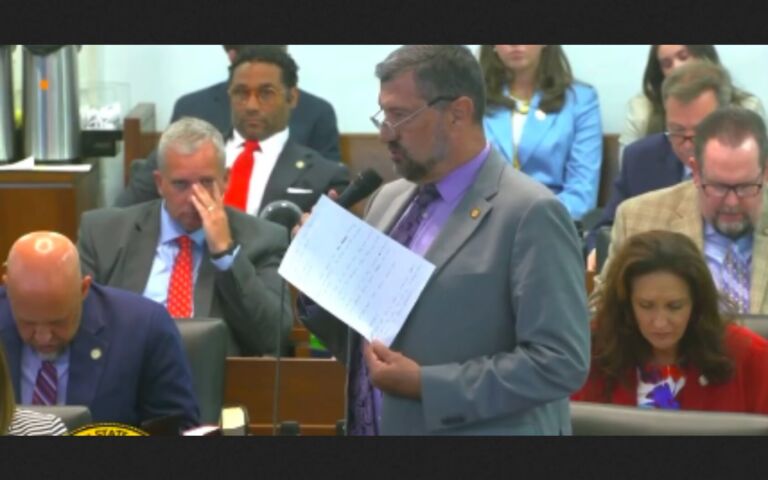
The North Carolina House has advanced legislation that would create a uniform process for municipalities and property owners to seek deannexation, shifting many boundary disputes away from the General Assembly while preserving lawmakers’ constitutional authority over municipal boundaries.
House Bill 199, Authorize Municipal Deannexation, passed its second reading on a 95-9 vote on July 2. The proposal would establish procedures allowing municipalities or qualifying property owners to initiate deannexation requests instead of requiring the legislature to approve individual local bills in many cases.
Supporters described the measure as a government reform that creates a predictable statewide process. Opponents said the legislation falls short because it establishes procedures without guaranteeing relief for property owners seeking to leave municipal boundaries.
Rep. Paul Scott, R-Rutherford, the bill’s primary sponsor, said the legislation grew out of repeated requests.
“This bill comes out of the experience of the House Finance Committee, where we received deannexation bills after deannexation bills,” Scott told House members.
Scott said lawmakers formed a working group to develop a more consistent approach to handling those requests.
“I would remind all of us that in Section 1, Article VII of the North Carolina Constitution, the General Assembly alone is empowered to provide for the organization and government and the fixing of boundaries of cities, counties and towns,” Scott said. “There’s nothing in this bill that changes that constitutional duty.”
North Carolina is a Dillon Rule state under this framework, a legal principle stating that local governments only have the powers explicitly granted to them by the state legislature or those strictly implied to carry out their express duties.
Scott said the legislation establishes procedures that allow disputes to be addressed locally before reaching the legislature.
“What this does is sets up a process where we do not have to be involved in every single local issue,” Scott said. “There is a process for a municipality to initiate deannexation. There’s a process for citizens to initiate deannexation. There are safeguards to make sure everyone understands what that involves.”
The proposal requires notice to affected parties, public hearings, coordination with counties, and review of municipal services that would be affected if property leaves a town or city. The bill also establishes an appeal process.
The debate centered largely on whether creating a formal process is enough to protect property owners.
Rep. Mark Pless, R-Haywood, said he has supported deannexation requests brought by constituents, particularly those who were involuntarily annexed before North Carolina changed its annexation laws more than a decade ago.
“I have always been willing to listen to any constituent that came to me and said, ‘Hey, I would love to be deannexed,’” Pless said.
He argued that the legislation does not create objective standards requiring municipalities to approve qualifying requests.
“The bill gives no guarantees,” Pless said. “This doesn’t set a precedent. This does not say, ‘We are going to grant you if you meet XYZ.’ This just says, ‘Hey, here’s the process that you can go through.’ It still boils down to the exact same thing. You ask, and we can say no.”
Pless cited constituents who, he said, were involuntarily annexed years ago and unsuccessfully challenged those annexations in court because state law provided no clear legal basis for deannexation.
One of his chief concerns involves provisions allowing municipalities to recover certain infrastructure costs when property is removed from municipal limits.
“If you choose to be deannexed, they can go and depreciate the cost of that for 10 years and now charge you to be removed from the city,” Pless said. “You didn’t ask to be put in the city. They took you.”
Pless also questioned whether the legislation adequately protects property owners who are not registered voters due to felony convictions or short-term rental homeowners. Under portions of the bill, petitions and referendums may depend on registered voters rather than all property owners.
“If you own a piece of property… you can’t vote, but you can purchase a piece of property and provide for your family,” Pless said. “I don’t think that’s fair.”
Rep. Frank Iler, R-Brunswick, raised similar concerns, noting that many coastal communities have large numbers of nonresident property owners.
“In their town, a registered voter and a property owner may not be the same,” Iler said. “I’m not against the idea, but this bill needs a lot of work.”
House members also questioned whether developers could use the proposed deannexation process.
Rep. Zack Hawkins, D-Durham, asked whether the legislation would create “a lane” for developers seeking to remove property from municipal boundaries.
Scott responded that developers would have access to the same petition process available to other property owners, provided they meet the statutory requirements.
“It depends on which way the deannexation is initiated,” Scott said, explaining that municipal-initiated requests follow one procedure while property owner petitions follow another. “If you’re the property owner and you’re the one initiating, there is a petition process that you fill out.”
Supporters acknowledged the bill may require additional revisions before becoming law.
Rep. Harry Warren, R-Rowan, asked Scott whether concerns raised during debate could be addressed as the legislation moves through the General Assembly.
“Absolutely, 100%,” Scott responded.
Warren, who said he has watched numerous deannexation bills move through the House Finance Committee over the years, said establishing a standardized process could reduce the need for repeated legislative intervention.
“I commend Rep. Howard for putting together a small committee to come up with a due process for it,” Warren said. “I think it’s a good bill, and I think any issues with it can be addressed as it moves forward.”
Because the House approved the measure only on second reading, lawmakers will have another opportunity to amend the legislation before final passage. If approved by the House, the bill would move to the Senate for further consideration, where additional revisions remain possible.
The debate reflects broader questions about balancing private property rights with municipal authority. While supporters argue the bill modernizes an outdated legislative process, opponents contend the proposal should provide clearer standards guaranteeing deannexation when property owners meet specified criteria.
For now, lawmakers on both sides agreed on one point: the current system, which frequently requires the General Assembly to consider individual deannexation bills, is due for review.
“House advances municipal deannexation overhaul” was originally published on www.carolinajournal.com.

![[WBT107.9FM] app promo graphics 2025](https://wbt.com/wp-content/uploads/sites/84/2025/12/17653898024341.jpg?quality=80&strip=all&w=150&crop=0,0,100,150px)