Stein signs 4 bipartisan bills into law
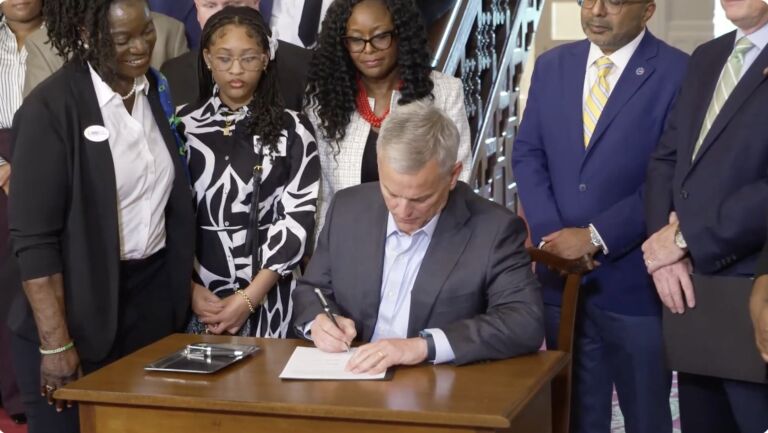
Gov. Josh Stein signed four bipartisan bills into law Monday afternoon at the Executive Mansion.
The bills address gang violence, involuntary commitment, housing affordability, and state employee benefits — issues supported by lawmakers in both parties this session.
Stein welcomed legislators and advocates to the mansion for the ceremony.
House Bill 1173: Jaleeyah’s Law
Jaleeyah Tune, a 13-year-old Goldsboro girl, was shot and killed in a random act of gang violence just days before Christmas 2025.
House Bill 1173, Jaleeyah’s Law, strengthens North Carolina’s criminal gang laws by increasing penalties for gang activity involving minors or firearms and funding additional prosecutors and investigators for gang cases.
Rep. John Bell, R-Wayne, introduced the bill in honor of Jaleeyah, who was one of his constituents.
“I want people to remember her name, and that an innocent little girl is not with us today because of a senseless act of violence,” Bell said.
Jaleeyah’s mother, Whitney Brown-Tune, said her family is still grieving.
“I cry daily because I miss my daughter,” Brown-Tune said. “My kids are hurting. We are hurting. This is not going to stop the violence, but it will help.”
House Bill 1104: Improve IVC Process and Enhance Public Safety
After a series of tragedies involving mental illness, including the murders of Iryna Zarutska in Charlotte and Zoe Welsh in Raleigh, House Speaker Destin Hall created the House Select Committee on Involuntary Commitment and Public Safety.
House Bill 1104, Improve IVC Process and Enhance Public Safety, revises the state’s involuntary commitment process and creates an inpatient capacity-restoration program for defendants found incapable of proceeding because of serious mental illness.
Rep. Dr. Tim Reeder, R-Pitt, chaired the committee, which developed the legislation.
Reeder said the committee worked to balance “protecting the public from criminal behavior while ensuring those with serious mental illness receive the care they desperately need.”
House Bill 162: Parking Lot Reform/Stormwater Control
Excessive parking mandates can cost renters up to $200 to $300 per month, according to Stein.
House Bill 162, Parking Lot Reform/Stormwater Control, prohibits most local governments from requiring a minimum number of off-street parking spaces for new developments. The law also allows local governments to offer developers incentives for stormwater control measures that go beyond what state law requires.
Stephanie Watkins-Cruz, director of housing policy at the North Carolina Housing Coalition, said the bill shows how small policy changes can make a big difference in housing affordability for owners and renters.
“House Bill 162 reminds us that housing is not a partisan issue — it’s a human one,” Watkins-Cruz said. “This legislation reflects what’s possible when people from different perspectives and sectors come together around a shared goal.”
Watkins-Cruz said both developers and conservationists supported the bill.
Senate Bill 1041: Public Workforce Modernization Act
North Carolina’s state human resources system has not had significant changes since 1965, according to Sen. Kevin Corbin, R-Macon.
Senate Bill 1041, the Public Workforce Modernization Act, overhauls the state’s human resources system by updating rules for classification, compensation, hiring, onboarding, employee discipline, grievances, and other personnel policies.
The bill also increases paid parental leave for state employees to 12 weeks for both mothers and fathers. Previously, mothers received eight weeks, while fathers received four weeks.
Anna Troxler, a teacher at Broughton High School and mother of two, said she received no paid parental leave when her first child was born but received eight weeks when her second child was born.
“It’s so important for teachers to be able to take care of themselves in order to take care of their students,” Troxler said.

In a post on X, the speaker’s office responded to Stein signing the three House bills.
“Today, the Governor did the RIGHT thing by signing these bills into law,” the office wrote. “It’s nice to see him putting public safety ahead of politics for a change. NC families should ALWAYS come first.”
Fifteen bills remain on Stein’s desk, including the state budget. Lawmakers passed the budget Thursday before adjourning until July 27.
“Stein signs 4 bipartisan bills into law ” was originally published on www.carolinajournal.com.