Harris takes aim at federal rule career schools call unfair
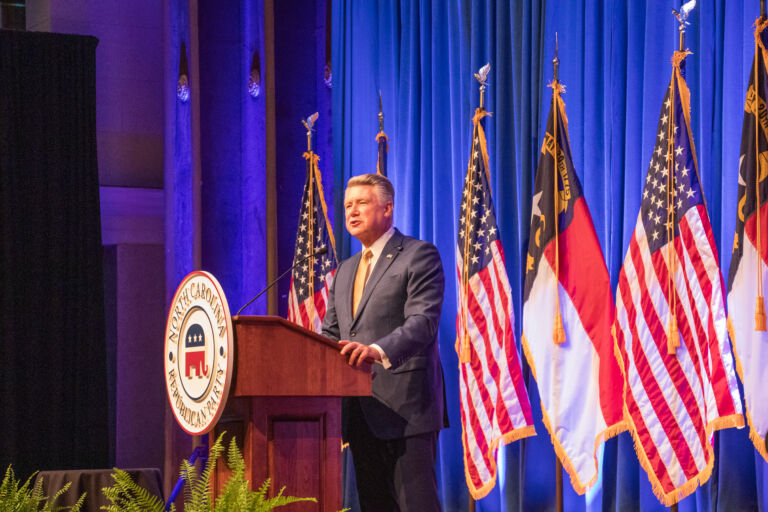
United States Rep. Mark Harris, R-NC8, on July 2, introduced legislation to repeal the federal “90/10 rule,” a Higher Education Act provision that applies only to for-profit colleges and career-training schools and requires them to draw at least 10% of their revenue from sources other than federal student aid.
Harris’ bill, the Promoting Access and Revenue Integrity Through Institutional Transparency (PARITY) Act, is the House companion to a Senate measure introduced in April by Sen. Jim Banks, R-Ind. The legislation was referred to the House Education and the Workforce Committee, on which Harris sits.
“Washington should not pick winners and losers in higher education,” Harris said in a statement. “Career schools give students the opportunity to gain practical skills, pursue in-demand jobs, and choose the education path that best fits their goals. In North Carolina and across the country, these workforce-focused institutions help prepare students for the jobs our communities depend on.”
“By repealing the outdated 90/10 rule, the PARITY Act ends a double standard that singles out career schools and ensures every institution is treated fairly,” Harris added.
The bill would strike two sections of the Higher Education Act: The first sets the non-federal revenue requirement for proprietary schools, while the second governs how the rule is implemented and enforced. Public and nonprofit colleges that also receive federal student aid are not subject to the requirement.
The effort drew the backing of the education committee’s chairman. “The 90/10 rule is an outdated policy that unfairly limits” student choices, said Rep. Tim Walberg, R-Mich. “Repealing it would expand access to high-quality education and career training so every school is held to the same standards… Congress should follow suit and finally retire this outdated policy.”
The rule has long been contested. Congress created it in the late 1980s and early 1990s — originally as an 85/15 requirement — on the theory that schools relying almost entirely on taxpayer dollars faced too little market discipline. Consumer advocates and some veterans’ groups have defended it as a guardrail against predatory recruiting, arguing that for-profit schools have targeted students, including veterans, whose aid dollars help institutions meet the cap.
Supporters counter that the accountability landscape has already changed. Through the Working Families Tax Cuts Act, Congress enacted a universal earnings and return-on-investment standard tied to Title IV eligibility that applies across institution types — a framework Harris and Banks say makes the 90/10 rule redundant. The House-passed version of that law repealed the 90/10 rule outright, but the repeal was dropped from the Senate version that became law.
The bill also follows a July 2025 move by the US Department of Education to loosen its interpretation of the rule, allowing revenue from distance-education programs to count toward the non-federal share.
North Carolina is home to roughly 44 for-profit, or proprietary, colleges and career-training schools that participate in federal student aid — 14 four-year institutions, eight two-year colleges and 22 trade schools of less than two years — enrolling about 10,900 students combined, according to US Department of Education data in the Integrated Postsecondary Education Data System for 2024-25.
They range from Strayer University’s North Carolina campus, the largest with roughly 3,000 students, and career schools such as MyComputerCareer in Raleigh and the NASCAR Technical Institute in Mooresville, to the multi-campus Miller-Motte College and dozens of smaller cosmetology and barber programs.
“Harris takes aim at federal rule career schools call unfair” was originally published on www.carolinajournal.com.