Helene drives push for stronger emergency communications

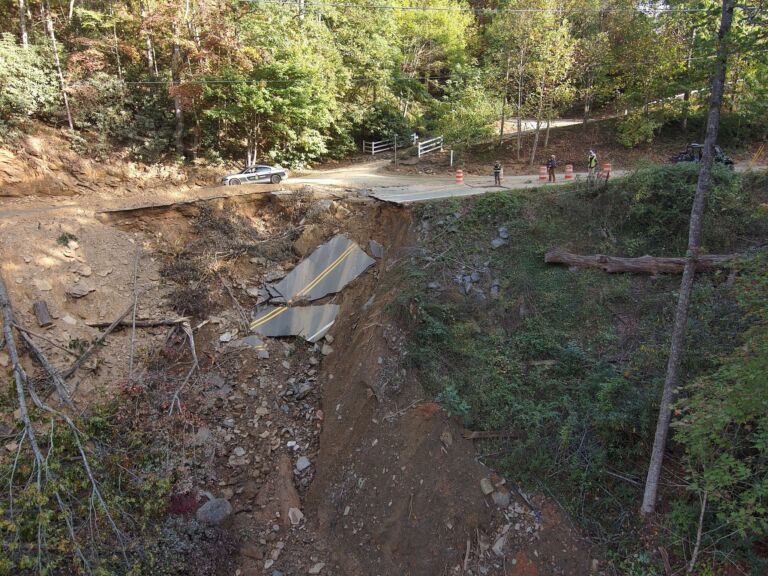
Officials believe Hurricane Helene exposed a hard truth about emergency response in western North Carolina: When communications fail, nearly every aspect of public safety is affected.
State officials, emergency planners, and first responders told members of the Governor’s Recovery Office for Western North Carolina (GROW NC) Advisory Committee on June 22 that strengthening communications infrastructure has become one of the state’s top public safety priorities. Their message was consistent — future disasters will require layered systems capable of surviving catastrophic failures, not reliance on any single technology.
The discussion centered on two complementary efforts: a regional communications resilience plan developed after Helene and the North Carolina State Highway Patrol’s proposal to expand its statewide VIPER emergency radio network with 31 new towers across western North Carolina.
It’s included in Gov. Josh Stein’s budget proposal.
“We hope these kind of things never happen again,” committee co-chair state Sen. Kevin Corbin, R-Macon, said before the presentations. “But unfortunately, we need to make those preparations. And a big part of that is communications and communications resiliency planning.”
Helene exposed communications weaknesses
Sara Nichols, energy and economic development program manager for the Land of Sky Regional Council, said Helene revealed vulnerabilities that had developed over decades.
“Helene didn’t create our communication gaps,” Nichols said. “It exposed and accelerated them.”
As floodwaters destroyed infrastructure and widespread power outages spread through the mountains, cellular networks, broadband systems, fiber lines, and other communications infrastructure failed in rapid succession.
“It wasn’t an isolated outage,” Nichols said. “It was a cascading loss of capacity.”
The failures affected emergency responders, hospitals, local governments, utility companies, businesses, and residents trying to contact loved ones or call for help.
“When things fail, residents can’t call for help, coordinating entities couldn’t speak to each other, and systems that we’ve created that need to be online were dependent on wires and signals,” Nichols said.
According to data presented during the meeting, roughly 75% of cellular sites in the affected region were out of service after the storm. Approximately 200,000 wireline and cable customers lost service, while nearly 1,700 miles of fiber optic infrastructure sustained damage.
Nichols said the communications crisis became most severe just as residents needed assistance most.
“By the 28th, we have almost no network in Western North Carolina,” she said, describing the days immediately following the storm when residents were running low on food, water, medications, and fuel.
Emergency radios became the lifeline
While commercial communications systems failed, the North Carolina State Highway Patrol’s Voice Interoperability Plan for Emergency Responders, known as VIPER, continued operating and became the backbone of emergency communications.
Major Kevin Owens, director of communications, information technology, and logistics for the Highway Patrol, said the statewide radio network allowed emergency responders from multiple agencies to continue coordinating rescue and recovery operations after conventional communications collapsed.
“The VIPER Network stayed up and we were able to use it for communications,” Owens said. “It was the only reliable method that we had for quite a bit of time up there.”
Owens said emergency communications during future disasters cannot depend on one system alone.
“VIPER, Starlink, satellite phones, ham radio — they all serve to improve communications and work to complement each other,” he said.
Patrol seeks 31 new towers
Although VIPER remained operational during Helene, Owens said the storm confirmed the need to improve coverage throughout the mountains.
The Highway Patrol is seeking funding to construct 31 additional VIPER communications towers across western North Carolina.
Owens said modern radio modeling identified coverage gaps that could leave emergency responders with limited communications in some mountainous terrain.

“If the funding was required for these 31 sites, that’s looking about a five- to seven-year build-out period under perfect conditions,” Owens said, noting that permitting, environmental reviews, and local approvals would affect construction schedules.
Unlike traditional radio towers, Owens said the proposed sites are intended to support multiple public safety and communications needs.
He said he’s a Rutherford County native and understands the terrain and the need in more remote areas.
“So if we’re going to put a VIPER tower there, then we can put the broadband on there,” Owens said. “We can also put commercial space to some of the cell phone providers as well and allow them to expand cell phone coverage into some of these areas in western North Carolina where cell phone coverage is not great.”
Officials said the approach could strengthen emergency communications while improving broadband access and commercial wireless coverage in rural communities.
Building redundancy instead of relying on one system
Nichols said one of the most important lessons from Helene is that communications resilience depends on coordination as much as technology.
The Land of Sky Regional Council spent the past year working with 113 organizations representing emergency management, healthcare, utilities, telecommunications companies, local governments, nonprofits, and educational institutions to develop a regional communications resilience strategy.
Researchers found many organizations believed they had redundant communications because they subscribed to different wireless providers. In reality, multiple carriers often depended on the same fiber backbone.
“We thought we had multiple providers,” Nichols said. “It turns out they were all kind of piggybacked on the same backbone infrastructure.”
The regional plan recommends creating stronger partnerships before disasters occur, expanding backup communications, improving public messaging, developing resilience hubs, strengthening infrastructure, and improving coordination among government agencies and private providers.
“The central recommendation we have is to build the framework, not just the equipment,” Nichols said. “We do not have a recommendation that just throws money at a lot of various projects, but creates a system where we all can coordinate and work together at its heart.”
Owens said the Highway Patrol has already upgraded portions of the VIPER network since Helene, including automatic rerouting technology designed to keep communications operating if fiber lines fail.
“This was not in place during Hurricane Helene,” Owens said. “Had it been, we would have seen probably zero downtime with the network and zero downtime with any towers because this would allow us to reroute the traffic.”
As North Carolina continues rebuilding after one of the state’s most destructive natural disasters, officials said communications infrastructure has become more than a technology issue.
For emergency responders and residents alike, they said, reliable communications are a core public safety function that determines how quickly help can be requested, coordinated, and delivered when the next disaster strikes.
“Helene drives push for stronger emergency communications” was originally published on www.carolinajournal.com.


![[WBT107.9FM] app promo graphics 2025](https://wbt.com/wp-content/uploads/sites/84/2025/12/17653898024341.jpg?quality=80&strip=all&w=150&crop=0,0,100,150px)