Lawyer urges top NC court to set aside recent marijuana odor ruling

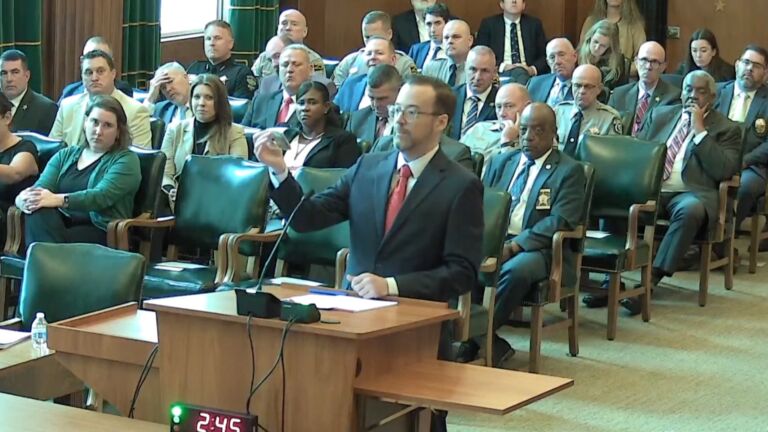
A lawyer representing two clients in marijuana-related cases at the North Carolina Supreme Court is asking that court to set aside a recent unanimous ruling against one of his clients.
Benjamin Kull argued in a court filing Tuesday that the decision against Tyron Lamont Dobson “repeatedly violates the rule of law in order to allow the very type of ‘evil the [Fourth] Amendment was designed to prevent.’”
Kull is also seeking new oral arguments in Dobson’s case and a separate dispute involving Codie Bruce Schiene. Kull presented the original arguments in both cases last September. The Supreme Court has not issued a decision in Schiene’s case.
“There is no painless way to accurately describe what’s going on here: This Court’s decision is the result of either (i) a cascade of consequential and indefensible oversights, or (ii) anti-constitutional judicial activism (i.e., the type that chips away at North Carolinians’ constitutional rights, in order to give the police more discretionary power to infringe on those rights). Either way, it’s not too late for corrective action,” Kull wrote Tuesday about the Dobson ruling.
The Dobson decision “ignores the long-standing precedent of the United States Supreme Court, by failing to ask and answer the correct question when reviewing the challenged ruling at issue here,” Kull argued. “The correct question is: Was there probable cause to believe the police would find evidence of marijuana-related crimes? But this Court’s decision asks and answers the wrong question: Was there probable cause to believe the police would find unspecified evidence of any unspecified wrongdoing?”
“By asking and answering the wrong question, this Court’s decision fatally undermines the very reason for which the Fourth Amendment was enacted,” he continued. “This is the most significant of the problems here, because in purely practical terms, it rewrites the United States Constitution in a way that gives the police more discretionary power to infringe on North Carolinians’ constitutional rights.”
During last September’s oral arguments, Kull produced a bag of what he said was legal cannabis. He argued that the cannabis would have the same odor as illegal marijuana.
“[T]his Court’s decision also needlessly answers a consequential public policy question that, according to this Court’s own precedent, is the type of question that the General Assembly should be answering: If North Carolinians lawfully possess lawful property, should they have to hide it from the police?” he asked in Tuesday’s court filing. “If those North Carolinians want to avoid any risk to their freedom and their constitutional rights, then the practical significance of this Court’s decision is clear: Yes, lawful property must be hidden from the police in North Carolina.”
“[B]y continuing to speak of ‘the odor of marijuana’ — when what we really mean now, in the age of legal cannabis in North Carolina, is ‘the odor of cannabis’ (which could be either marijuana or hemp) — this Court’s decision also flaunts the General Statutes and undisputed scientific fact, in a way that results in needless confusion in our case law,” Kull wrote.
With a new round of oral arguments, “all the parties — including the State’s top law enforcement organizations that have interjected themselves as amici curiae — may openly and honestly discuss the ways in which routine policing must now evolve in the age of legal cannabis,” Kull added.
The state Supreme Court ruled unanimously on May 22 in State v. Dobson. The defendant argued that neither the cannabis odor alone nor the combination of cannabis and cologne justified a warrantless search in Greensboro in 2021 that led to criminal charges against him.
“Because the odor of legal hemp and illegal marijuana are virtually identical, the question arises how that smell can factor into a law enforcement officer’s determination of when probable cause exists to conduct a warrantless search consistent with the Fourth Amendment’s protection against unreasonable searches and seizures,” Justice Anita Earls explained in her opinion.
“Today we hold that under applicable federal Fourth Amendment doctrine, we continue to follow our precedents which require examination of the ‘totality of the circumstances’ to determine whether probable cause exists to conduct a warrantless search,” Earls wrote.
“Below, the trial court determined that the totality of the circumstances justified the police search of Mr. Dobson’s vehicle and person,” Earls added. “The Court of Appeals affirmed that order, holding that the officers’ detection of a cover scent provided a basis to support probable cause for a search in addition to their detection of the odor of marijuana.”
Dobson objected to the Appeals Court’s ruling and accused judges of applying “an unconstitutional ‘double odor’ rule” linking the marijuana odor and a cover scent, Earls explained. “The State argues that the ‘odor alone’ doctrine is good law; and in the alternative, that the Court of Appeals did not create a ‘double odor’ rule and other facts gave rise to probable cause.
“We hold here that the smell of marijuana and the smell of a cover scent were not the only factors on which the officers relied in making their probable cause determination,” Earls wrote for the unanimous court. “Considering the totality of the circumstances, we hold that the officers’ search was objectively reasonable.”
A unanimous state Supreme Court issued a related May 22 ruling in State v. Rowdy. That decision upheld the conviction of defendant Terrel Dewayne Rowdy based on a 2020 arrest in Forsyth County. Kull did not represent Rowdy.
“This is a companion case to today’s decision in State v. Dobson, which reiterates that the odor of marijuana is a factor to be considered when analyzing the totality of the circumstances to determine whether an officer had probable cause to conduct a search,” wrote Justice Allison Riggs.
“Terrel Rowdy was subject to two searches in connection with a traffic stop: a search of his person and a warrantless search of his automobile,” Riggs explained. “The searches were only proper if officers had reasonable suspicion to conduct the search of Mr. Rowdy’s person and probable cause to conduct the warrantless automobile search. The reasonable suspicion and probable cause analyses examine whether the totality of the circumstances, including the odor of marijuana, justifies a stop, search, or seizure.”
“Under the totality of the circumstances, the search of Mr. Rowdy’s person was justified by his refusal to pull over for the traffic stop, his presence in a ‘high crime area,’ his prior convictions for narcotics and weapons offenses, the odor of marijuana, and his evasive behavior during questioning,” the opinion continued. “The warrantless search of his automobile was justified by the above factors and the additional discovery of what officers ‘believed to be a marijuana blunt’ during the search of his person.”
“We hold that the search of Mr. Rowdy’s person met the reasonable suspicion standard and the warrantless search of his automobile met the probable cause standard, so the trial court did not err in denying his motion to suppress evidence,” Riggs wrote.
When arguing for Dobson and Schiene last September, Kull cited the General Assembly’s 2018 decision to legalize smokable hemp. Police across North Carolina no longer have a way to distinguish between legal hemp and illegal marijuana, he said.
“People of North Carolina through their elected legislative representatives have made a paradigm-shifting choice,” Kull argued. “They have created a legal form of cannabis in North Carolina.”
State law allows people to buy and use hemp, Kull added. “The question for this court is whether you are going to impose a tax on that lawful behavior,” he argued. “Not a tax that people will be forced to pay with money, but a tax that people will be forced to pay with their constitutional rights.”
Conditions have changed for law enforcement officers, Kull argued. “When the odor was always the odor of contraband, that odor was like Popeye’s spinach,” he said. “It immediately gave them a superpower — superpowers that they did not otherwise have.”
Kull specifically targeted the state Appeals Court’s State v. Greenwood precedent from 1980. It allowed law enforcement officers to conduct warrantless vehicle searches based solely on cannabis odor.
State Special Deputy Attorney General Zachary Dunn urged the high court in the Schiene case to preserve the odor rule. The Schiene arguments preceded those in the Dobson and Rowdy cases.
“This case and the two that follow present one overarching question, which is whether the odor of marijuana — standing alone — provides probable cause for the search of a vehicle after the passage of the Industrial Hemp Act,” Dunn argued. “If the answer to that question is yes, this case, Dobson, and Rowdy all come out the same way. Probable cause existed, and the searches were proper.”
US Supreme Court precedent requires law enforcement officers to weigh the “totality of the circumstances” before proceeding with a warrantless vehicle search. The Greenwood case allowed North Carolina authorities to cite only the odor, Dunn explained.
“The way it’s articulated is the odor of marijuana is the only circumstance in the totality of circumstances that mattered,” Dunn explained. “If you smell the odor of marijuana, then that is enough for probable cause.”
“Lawyer urges top NC court to set aside recent marijuana odor ruling” was originally published on www.carolinajournal.com.


![[WBT107.9FM] app promo graphics 2025](https://wbt.com/wp-content/uploads/sites/84/2025/12/17653898024341.jpg?quality=80&strip=all&w=150&crop=0,0,100,150px)