Just because it’s a bill, doesn’t mean it’s being considered

I opened Facebook a couple weeks ago, a rare occurrence these days, and saw a long post from a friend about how North Carolina was about to start executing women and doctors involved in abortions. Instead of reading the many paragraphs of passionate prose, I noted the bill number and searched the North Carolina General Assembly website for it.
House Bill 1231, Constitutional Amendment/Life at Fertilization, would ask voters to consider a constitutional amendment affirming that human life begins at conception. There have been many personhood amendments proposed over the years in states across the country and federally. But this one had some unique elements.

The first unique element is that it said that, because this was a separate human life, “Any person who willfully seeks to destroy the life of another person, by any means, at any stage of life, or succeeds in doing so, shall be held accountable for attempted murder or for first degree murder, respectively.”
So those who seek or carry out the abortion, then, could indeed, as my friend suggested on Facebook, be convicted of first degree murder, a capital offense.
And in the introduction of the bill, it says that people’s right to life is protected, “from fertilization until natural death, so long as that person is not convicted of a capital offense.” This more than implies that the woman and doctor involved would be at risk of the death penalty, since those guilty of a capital crime are not included in this protection of life.
The next unique element is that the bill says that “Any person has the right to defend his or her own life or the life of another person, even by the use of deadly force if necessary, from willful destruction by another person.”
This seems to create a very plausible legal justification for vigilante violence against those involved in abortion, in addition to the threat of state-imposed death penalty.
With all that in mind, I immediately thought, this bill is going nowhere. And looking down to the bottom of the bill page, it was in the House Rules Committee, where many bills that are going nowhere are sent, never to return.
Last week, Speaker of the House Destin Hall, R-Caldwell, put any further doubt to bed when he said, as quoted by the News & Observer, “This is not a serious bill,” and it wouldn’t be going anywhere.
That, of course, didn’t prevent attention on the bill from national media from growing. In addition to friends, then a family member reached out to ask if North Carolina was really opening up those involved in abortion to vigilante violence and the death penalty, which they read in a popular national Christian magazine. I assured them that was not the case.
The truth is, all members can file bills on pretty much anything they want. But just because somebody filed something, it doesn’t mean “North Carolina” or even “the state legislature” is pursuing this end.
Over the years, I’ve seen many unserious bills, as Hall called this one, be introduced, get a chuckle or a raised eyebrow, and then disappear into the House or Senate Rules Committee — which is exactly what happened here. Are they worth further discussion in the media or by the wider culture if they are not being discussed seriously by lawmakers? Maybe a bit, if the proper context is included. But it’s almost inevitable that they will gain far more discussion than that if it’s something that hits the right nerve.
Not all unserious bills are about such serious topics though. For example, many House Democrats signed onto a “Skip the Stuff” bill this session that would ban restaurants from providing single-use forks and ketchup packets unless directly asked.
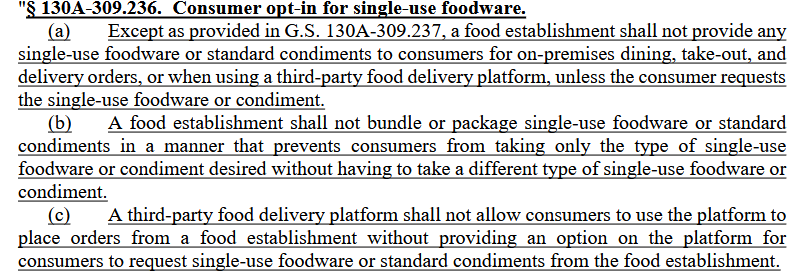
Guess where that one immediately went (and where it will die)? House Rules Committee.
This year, the House Democrats also had a bill to create a pilot program aimed at increasing diversity in pickleball, House Bill 249. That’s also going nowhere.
During the previous term, some Republicans filed a bill, Senate Bill 430, to ban participation trophies from youth sports, at least those that get government funding. That one was sent to Senate Rules and never reemerged.
This is actually a healthy dynamic. Some legislator has an idea for a bill they think will improve life for those in their district and the state as a whole. They get the Bill Drafting Division to draw that idea up into its most legally and conceptually defensible form. Then they see if anyone else agrees that it would improve things.
If many others agree, especially those in leadership, it has a good chance of becoming law. If not, you may never hear about it — unless it shares some characteristics with the bills we discussed above. But it’s important for all those ideas to get out there and be considered, at least to some degree.
“Just because it’s a bill, doesn’t mean it’s being considered” was originally published on www.carolinajournal.com.

![[WBT107.9FM] app promo graphics 2025](https://wbt.com/wp-content/uploads/sites/84/2025/12/17653898024341.jpg?quality=80&strip=all&w=150&crop=0,0,100,150px)