Prospects emerge for future NC Senate leader
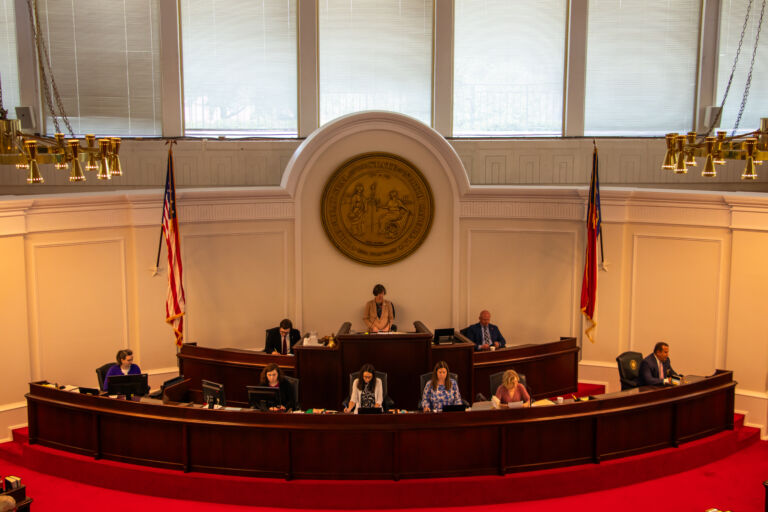
Senate Leader Phil Berger’s loss in the 2026 primary elections has set off early maneuvering among Republicans over who will succeed him as president pro tempore.
Berger, R-Rockingham, has served as president pro tempore since 2011, making him the chamber’s longest-serving leader. During his tenure, he has played a central role in shaping the Senate’s agenda and guided Republican policy priorities as the party gained and maintained control of the General Assembly.
Senate leadership has remained unusually stable for decades.
“The Senate president pro tempore job has emerged over the past three decades as a major power position in North Carolina politics,” said Mitch Kokai, senior political analyst at the John Locke Foundation. “With just two men—Democrat Marc Basnight and Republican Phil Berger—holding the post since 1993, many might label the top Senate leadership post as the most powerful job in state government.”
The timeline for selecting his successor remains unclear. While discussions about potential candidates have already begun, it is not yet clear whether a leadership vote will take place later in the 2026 session or be deferred until the start of the next legislative term in January 2027.
Andy Jackson, director of the John Locke Foundation’s Civitas Center for Public Integrity, outlined how the president pro tempore plays a central role in shaping legislative outcomes.
“The president pro tem assigns senators to committees, appoints members to state boards and commissions, and hires professional legislative staff,” Jackson said. “Those levers of power give the Senate leader significant influence over state policy.”
The transition also raises questions about the extent of Berger’s successor’s influence and how candidates may distinguish themselves from the current leadership.
Kokai said it remains unclear whether Berger’s successor will wield the same level of influence.
“It’s not clear that the next Senate leader will wield the same amount of power as either Basnight or Berger, but it’s clear that the next leader will have a chance to play a major role in shaping North Carolina public policy in the coming years,” Kokai said.
He also noted the political balancing act facing potential candidates.
“Those who are interested in the post will have to be careful,” Kokai said. “While Berger is still in office, it would be unwise to spend too much time talking about making significant changes in Senate operations. But it’s likely that the candidates will have to differentiate themselves from the current leadership team in some respects. Unless a candidate stakes out a position as ‘Phil Berger 2.0,’ he or she will have to explain any plans to make the Senate a better place than it is today.”
Based on their own comments and Carolina Journal’s conversations with political insiders, several Republican senators have emerged as possible contenders or have signaled interest in the position.
Sen. Ralph Hise, R-Mitchell
A longtime ally of Berger, Hise maintains a strong position within the Republican caucus and with veteran lawmakers. The current deputy president pro tempore has already stated he intends to seek the role of president pro tempore.
“I will put my name forward for consideration by our caucus,” Hise told NC Insider. “However, my focus right now is on continuing this session under Phil’s leadership and honoring his service to North Carolina. The season for deciding the next president pro tem of the Senate is after we have concluded our work for this session.”
Hise is serving his sixth term representing SD-47, which includes portions of western North Carolina. He co-chairs the Senate Appropriations/Base Budget Committee, Redistricting and Elections Committee, and the Joint Legislative Oversight Committee on Information Technology. He also played a leading role in the legislature’s most recent redistricting efforts.
Sen. Michael Lee, R–New Hanover
Lee currently serves as Senate majority leader. This role places him at the center of the chamber’s policy and messaging efforts. He has been a member of Senate leadership for several terms and has worked closely with top Republicans on legislative priorities.
Lee represents a competitive swing district, a factor that could weigh into leadership considerations.
In a statement on social media, Lee acknowledged ongoing discussions about Senate leadership and signaled his interest in the role:

Sen. Todd Johnson, R-Union
Johnson is a newer member of the chamber and is not closely aligned with Berger’s inner circle. He has drawn widespread attention for his vocal opposition to school closures during the COVID-19 pandemic. Johnson has indicated he plans to seek the role of president pro tempore, though he said his immediate focus remains on the upcoming session and passing a state budget.
In an interview with Brett Jensen of WBT, Johnson said: “There will come a time later into the session … to transition more to this race, and I do plan to throw my name in. I am very interested in the position,” but for now Johnson said he is “hyper focused on coming into session and getting a budget across the finish line.”
Johnson praised Berger’s tenure but also noted some policy differences. “Senator Berger has been a great servant to this state for many years and was able to do some amazing things,” Johnson said. “I don’t agree on everything, but North Carolina has been in a great position for the past 16 years because of his leadership.”
Sen. Amy Galey, R–Alamance
Galey has not formally announced a bid, but her name is also being considered, insiders told CJ.
Galey is a member of the Senate leadership team and an ally of Berger. She has been involved in advancing key Republican priorities and could represent continuity within the chamber’s existing leadership structure. If selected, she would become the first woman to serve as Senate president pro tempore.
Sen. Brent Jackson, R-Sampson
Jackson has also not publicly announced a bid for the position, but sources at the Senate told Carolina Journal his name has been mentioned as a potential contender. He brings seniority and a strong base in eastern North Carolina, particularly within the state’s agricultural community.
Jackson has served as one of the Senate’s key budget negotiators and has helped shape spending decisions. While he has not been part of the chamber’s top leadership in recent years, his experience and regional influence could factor into any leadership discussion.
High stakes
The leadership transition comes as lawmakers face several high-stakes policy issues, including finalizing a state budget, managing the ongoing rollout of Medicaid expansion, and addressing education funding and policy debates. Differences between the House and Senate on those issues have already surfaced in recent sessions.
“Whoever fills that position will heavily influence what policies are advanced in the General Assembly,” Andy Jackson said. “The main reason the legislature did not pass a budget last year was a conflict between Senate and House leadership.”
A change in Senate leadership could affect how negotiations unfold between the two chambers, particularly on budget and policy disagreements that have stalled legislation in the past.
While Hise, Johnson, and Lee have emerged as early frontrunners to succeed Berger, insiders tell CJ, the field remains fluid. Key decisions on timing and Republican caucus support remain unsettled.
The General Assembly’s legislative session is expected to begin on April 21.
“Prospects emerge for future NC Senate leader” was originally published on www.carolinajournal.com.
![[WBT107.9FM] app promo graphics 2025](https://wbt.com/wp-content/uploads/sites/84/2025/12/17653898024341.jpg?quality=80&strip=all&w=150&crop=0,0,100,150px)


