Moravian Easter: An NC tradition older than our nation
Home Moravian Church in Old Salem is known worldwide for its festivities during the Holy Week. And this year, this North Carolina tradition to mark the holiest time in the Christian calendar, happens to fall on the same weekend as the NCAA Men’s Basketball National Championship. But the Moravians have been at it a lot longer than the Tar Heels or Blue Devils.
“This is our March Madness,” Associate Pastor Craig Atwood told the Carolina Journal during a recent visit to historic church.
A FEAST FOR THE SENSES
Founded four years before the US Declaration of Independence, Home Moravian celebrated its semiquincentennial in 2021. April 5 marks the 254th celebration of its Easter sunrise service.
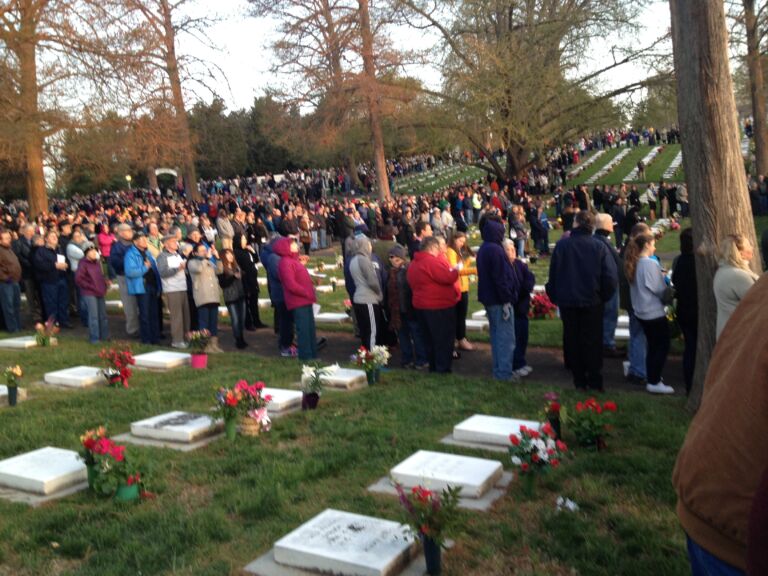
Past years have seen up to 8,000 attendees for the service, which features a brass band with hundreds of musicians playing traditional German-influenced Moravian hymns.
“The band has shrunk from over the last couple of decades, so it’s now only about 400,” Atwood said, noting that the musicians receive a hearty Moravian-style breakfast at the church beforehand.
The breakfast is closed to the public, but there are other opportunities during Holy Week for congregants and visitors alike to sample culinary treats, such as the Lovefeast buns served with a cup of coffee in a ceramic mug during the Good Friday evening service on April 3.
While they may not be consecrated like communion sacraments, the rolls, with Moravian spices and orange zest, are a key part of the ceremony.
“I know for a lot of people, just the smell of the coffee and the buns reminds them of many years of being in the church,” Atwood said.
Another unique component to the sunrise service is, of course, the setting. Congregants begin to gather outside the church in the twilight hours, with the full moon still looming overhead.
“One of my favorite moments is getting, just before the service starts, that pre-dawn, when the sky is beginning to lighten, and suddenly all the birds start singing,” Atwood said. “And everyone is so sleepy, there’s not a lot of loud talking or anything. We’re just standing there in the quiet and listening to the birds.”
That soon gives way, however, to bright lights and the cacophonous clatter of brass, as the procession makes its way from Salem Square to the nearby cemetery, known to Moravian churchgoers as “God’s Acre.”
As the stillness and solemnity gives way to boisterous rejoicing, Atwood says even the sky above seems to take notice.
“I probably have been to 40 or more Easter sunrise services,” Atwood said. “And even on years when it’s cold and rainy, I don’t know how it happens, but you always see the sunrise. And it is just so beautiful because it’s almost like we’re singing the sun up.”
RISING FROM THE GRAVE
A central tenet to the Moravian beliefs — perhaps even that from which the name derives, from the Latin mors (death) and ave (welcome) — is the idea that one’s worldly death is not cause for mourning but a rite of passage.
The church still considers those buried in its massive cemetery to be a vital part of the congregation. It even encourages children to play amidst the rows and rows of flat, uniform gravestones, in which members are buried according to the order of their passing, not by family plot.
“We believe that cemeteries are not frightening places,” said Atwood, who is also a retired professor of Moravian theology and history.

“For us, the cemetery is to remind us that these are brothers and sisters who have gone before us, but we are still related to them,” he said. “And it’s a joyful thing. Moravian funerals tend to be joyful, even when we’re grieving.”
The Moravian church’s unique views — including a longstanding belief that women should play an equal role in leadership — have sometimes made even fellow Protestants eye the 569-year-old faith with apprehension, despite (or perhaps because of) the Moravians’ belief that no one religious doctrine offers the true and only path to salvation.
Yet, past ostracization helped strengthen the Moravians’ tight-knit sense of community, with Salem, North Carolina, serving alongside Bethlehem, Pennsylvania, as their principal settlements in the New World.
When the tobacco industry and other growth factors turned Winston–Salem into a boom town during the 20th century, the church’s Easter traditions continued to grow, as well.
During World War II, the sunrise service at Home Moravian was broadcast globally via the Armed Forces Radio Network.
“It was the biggest [Easter service], had the biggest band, and that made it famous worldwide,” Atwood said.
The church still does a live television broadcast of the service, which then gets turned into a radio broadcast.
FROM SERMONS TO SWEETS
For Atwood, Home Moravian Head Pastor Ginny Hege Tobiassen, and other members of the vestry, the conclusion of the sunrise service hardly means the day is done.
The church also offers its traditional 10am service on Easter, although it tends to have a smaller crowd than the turnout on the preceding Palm Sunday, which begins the Holy Week.
“It’s a little unusual that a Moravian church’s attendance is actually higher on Palm Sunday than Easter [but in this case, that occurs] because so many people have been worshiping a long time,” Atwood said.
Otherwise, the later service on Easter offers mostly what one might expect at a typical Protestant church, he said. “What’s different is getting a sermon from a pastor that’s only had four hours of sleep.”
Afterward, Atwood, who grew up in the region and comes from a long line of Moravians, said he will likely head home for a nap, letting his family members focus on the all-important Easter cooking.
“Food is one of the ways that God shows his love for us, and we show our love for one another by sharing in food,” Atwood said. “I read somewhere someone who said that, whereas Roman Catholics are known for their fasts, Moravians are known for their feasts.”
Unfortunately, the Salem Tavern, a beloved institution that was known for its traditional Moravian fare, closed its doors in 2019.
But in its place arose Bread of Heaven, a soul-food restaurant that is run by a local pastor and continues to offer Moravian delicacies like bratwurst, pot roast, and pancakes.
It also serves the regionally famous Moravian chicken pot pie. “It’s not actually Moravian in origin,” Atwood noted. “It’s just something that was invented here [in Salem]. But it’s really good.”
All indications are that Bread of Heaven will keep its customary 7am to 11pm hours on Easter Sunday, although reservations are recommended. The restaurant also does event catering.
Other options include for sampling Moravian fare include Mrs. Pumpkin’s Deli, which features famous pot pies and even Lovefeast buns — although it is closed on Sundays.
For those seeking sweets, there is Wilkerson Bakery. A Winston–Salem institution since 1925, it makes in-demand hot-crossed buns and Moravian goodies like sugar cakes, which feature a potato-based bread baked with brown sugar and butter.
As for beverages, there is Lot 63, a coffeehouse, pub, and wine bar in Old Salem that serves a coffee drink based on the distinctly gingery Moravian spice cookies.
Atwood said he is partial to a leftover Lovefeast bun served with country ham and scrambled eggs. “For me, that’s part of Easter,” he said.
But he also recommended that any visitors unfamiliar with the Winston–Salem experience stop by Krispy Kreme, the well-known doughnut chain founded there in 1937, which also lays claim to some Moravian ties.
“I actually had a Krispy Kreme doughnut in South Korea in November,” Atwood said. “But Krispy Kreme started here in Salem, and one of the ways that got established is that Moravians would stop at Krispy Kreme after the service to get a doughnut. So, if you’ve never had a hot, fresh-made Krispy Kreme doughnut, you should go to the main location on Stratford Road and get that.”
“Moravian Easter: An NC tradition older than our nation” was originally published on www.carolinajournal.com.
![[WBT107.9FM] app promo graphics 2025](https://wbt.com/wp-content/uploads/sites/84/2025/12/17653898024341.jpg?quality=80&strip=all&w=150&crop=0,0,100,150px)


