Sometimes the public is wrong

In the food industry, you often hear the phrase, “The customer is always right.” If having your burger “your way” means eating it completely plain (like a high school friend of mine would), well, “We’re all entitled to our own ridiculous opinions,” as my uncle would say. But in the world of politics and economics, some of those ridiculous opinions may be further from the truth than others.
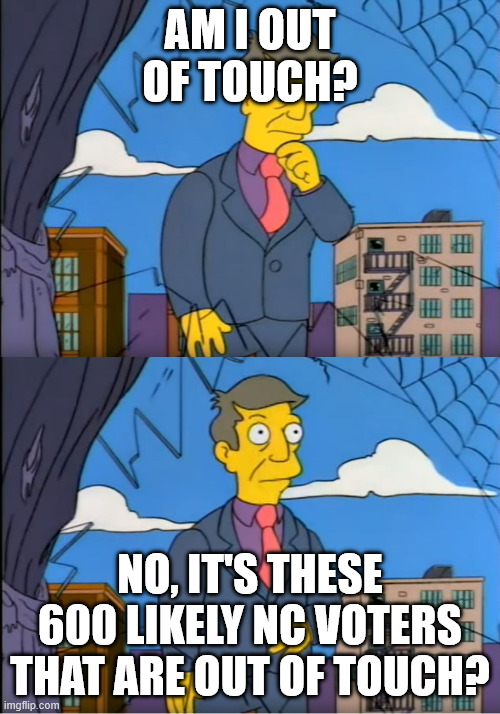
I’m sure everyone who works in politics and media has had the experience of reading a public opinion poll and shaking their head at the results, in disappointment or even disbelief. It can sometimes make you doubt yourself. You may even feel a little like Principal Skinner from the cartoon “The Simpsons” in the popular online “meme,” where he wonders if he’s lost touch with the kids of the day, or whether it is all the students at his school who are out of touch.
Sometimes though, the proverbial Principal Skinner is correct, and it IS everyone else that’s wrong. There were actually a few places in the latest CJ Poll where I had this experience — with apologies to these particular 600 likely North Carolina voters.
The one that jumped out the most was the response to whether building more housing would bring the cost of housing down. You’d assume 90% would say yes, and then another 10% would mess with the pollster by saying no. But, the response makes me think that, in addition to the civics requirement for K-12 schools, we should probably add some required economics classes — because 56% said they do NOT believe building houses would bring down housing costs.

In fact, the number of people who STRONGLY dispute this basic economic fact is about the same as the total number who believe it (32% to 34%). You have to wonder, if we asked, “Does building houses make housing MORE expensive,” how many of them would have answered yes?
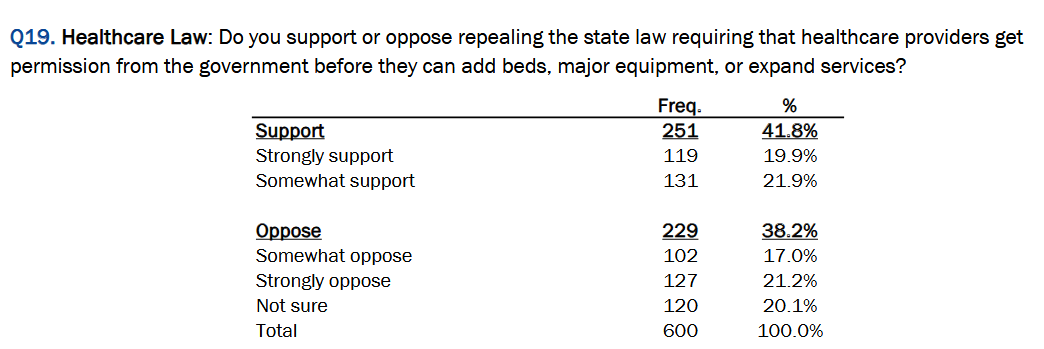
Another baffling area was when we asked whether health providers should have to get approval from a government board in order to justify buying new equipment or adding new capacity. Those strongly opposed to getting rid of these “certificate of need” laws (at 21.2%) outnumbered those strongly in support of repealing them (19.9%). Overall support (at 41.8%) was slightly higher than overall opposition (38.2%), but it was about even on what should be an obvious answer — get rid of these outdated, counterproductive regulations, now.
In the past few years, when you ask voters what their biggest complaints are about the state of things, or what issues animate them in a given election, they will tell you that prices are just too high! They will especially point to housing and health care as two areas where prices have gotten out of control.
So, one would think they would be loudly demanding that elected officials work aggressively to increase the supply of both… There should be protests in the street, with people holding signs saying:
“Let doctors open new practices!”
“Let hospitals expand services!”
“Let builders build buildings!” (maybe that one’s a bit repetitive)
“We need more housing!”
But instead, people want these two areas of the economy to operate by some other rules beyond basic supply and demand. When oil prices spike due to Iranian oil not making it to market, people call for other producers to increase exports to… bring prices back down. Those on the left (often) understand this too, as President Joe Biden would release oil from the strategic reserves when prices got too high.
Like more gas makes gas cheaper, more housing and health care makes those cheaper as well. Oh, well. Hopefully the next batch of 600 would score higher on an economics quiz. But they might not. Which is why free market think tanks have their work cut out for them.
“Sometimes the public is wrong” was originally published on www.carolinajournal.com.

![[WBT107.9FM] app promo graphics 2025](https://wbt.com/wp-content/uploads/sites/84/2025/12/17653898024341.jpg?quality=80&strip=all&w=150&crop=0,0,100,150px)

