Appeals Court rejects former Gates County elections director’s lawsuit
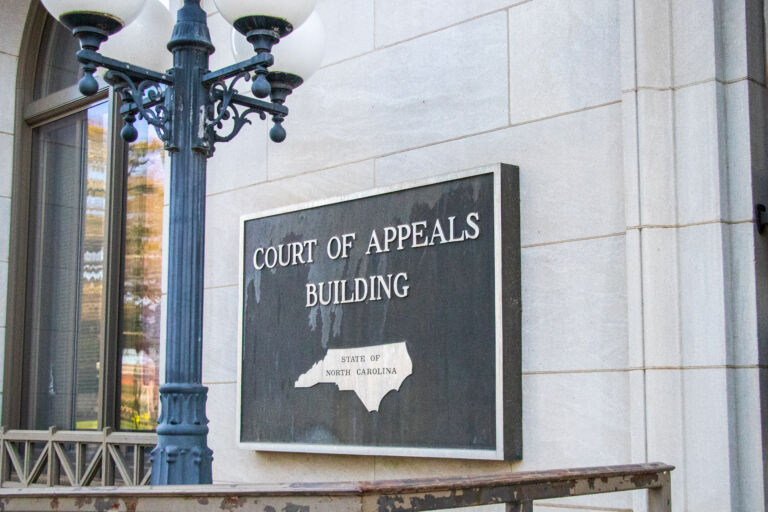
The North Carolina Court of Appeals has rejected a lawsuit Gates County’s former elections director filed against two top county officials. The suit alleged that the county manager and human resources director objected to a black woman leading the local elections office.
Clytia Riddick filed suit against the county and the two top employees in 2024 when she was still serving as county elections director. She eventually left the job while the lawsuit proceeded through the state’s second-highest court.
Riddick alleged that county manager Scott Sauer and human resources director Warren Perry attempted to violate her contract, engaged in illegal surveillance, and violated her civil rights. A trial judge rejected the arguments in March 2025.
A unanimous three-judge appellate panel affirmed the trial court’s decision Wednesday.
“This controversy arose out of a pay dispute beginning December 2023,” wrote Judge John Arrowood. “Until this time, Plaintiff regularly submitted signed time sheets to the Chairman of the County Board of Elections, who signed and forwarded them to Gates County’s payroll. Plaintiff alleges that Mr. Sauer and Mr. Perry began ‘accusing [her] of not working the hours that she had submitted on her timesheet.’”
“She specifically claims that Mr. Perry ‘stated that he reviewed security camera footage and made a determination as to when the plaintiff’s car was or was not in the Board of Elections parking lot, and that he deducted the hours from plaintiff’s paycheck based upon his arbitrary assumption,’” Arrowood added. “She alleges that Defendants ‘conducted illegal surveillance’ and ‘caused the Gates County Board of Commissioners to violate their statutory duty to compensate’ her, and that they were ‘acting out of malice and personal ill will’ and ‘outside of their scope and duties’ with ‘constant, repetitious, and malicious intimidation and harassment.’”
Appellate judges rejected Riddick’s arguments about her contract.
“Plaintiff has not alleged facts sufficient to show the existence of a valid contract which imposes no obligations upon her while requiring the Board of Commissioners to compensate her with a full annual salary irrespective of the ‘quality or quantity’ of her work,” Arrowood wrote. “Plaintiff says the alleged contract is statutory, imposing its duty pursuant to N.C.G.S. § 163-35(c). … But this statute does not impose the duty Plaintiff describes.”
Arrowood addressed Riddick’s arguments about the defendants’ motives. “Plaintiff alleges repeatedly that Defendants had no justification and acted only out of malice,” the judge wrote. “But this is a legal conclusion, and Plaintiff’s repeated use of the word ‘malice’ is no substitute for facts to support it.”
The case’s facts “show an administrator balancing the books.” Arrowood added.
The judge also questioned Riddick’s allegations about surveillance of her work. “Plaintiff pleads no facts supporting her contentions that Defendants had any motivation whatsoever to listen to her office chatter, let alone to use the intercepted office chatter for any nefarious purpose. Ultimately, this claim is a repetitive pastiche of paranoia and irrational conjecture,” Arrowood wrote.
“Defendants are employees of the county, which provides, maintains, and operates the security system,” he added. “Plaintiff explicitly claims that Mr. Perry said he monitored her to ensure that her recorded hours matched her actual attendance. Because she pled no facts sufficient to support her legal conclusions as to Defendants’ willfulness or malicious intent, her facts support only one reasonable deduction: that Mr. Perry looked at security footage incident to the protection of County funds from waste by County employees.”
Arrowood also targeted Riddick’s civil rights allegations.
“Again, Plaintiff’s complaint is replete with unwarranted deductions and unsupported legal conclusions, but light on facts,” according to the Appeals Court opinion. “It asserts a civil rights claim without making even one connection between Plaintiff’s facts and her claim that racial hatred motivated Defendants, other than the circular and conclusory claim that they ‘personally hate the fact that a Black female is the Director of Elections.’”
“At this stage, the pleading standard is not onerous, but valid complaints of this kind must contain, at a bare minimum, some scintilla of factual allegation lending credence to a theory of racially motivated conspiracy. We discern no such scintilla,” Arrowood wrote.
“The factual paucity of Plaintiff’s claim does not end with the allegedly racial motivation,” he added. “First, ‘[t]he claim suggests that Defendants conspired but fails to allege how this conspiracy came to be, or when, or where, or why.’ … The same goes for Plaintiff’s allegations of harassment; for her theory to prevail, at least one of the Defendants must have engaged in ‘repeated harassment,’ but she describes only one interaction with Mr. Perry and no interactions at all with Mr. Sauer.”
Chief Judge Chris Dillon and Judge Michael Stading joined Arrowood’s decision.
Arrowood is a Democrat seeking re-election this year. Dillon and Stading are Republicans.
“Appeals Court rejects former Gates County elections director’s lawsuit” was originally published on www.carolinajournal.com.

![[WBT107.9FM] app promo graphics 2025](https://wbt.com/wp-content/uploads/sites/84/2025/12/17653898024341.jpg?quality=80&strip=all&w=150&crop=0,0,100,150px)
