GROW NC panel weighs disaster investment zones
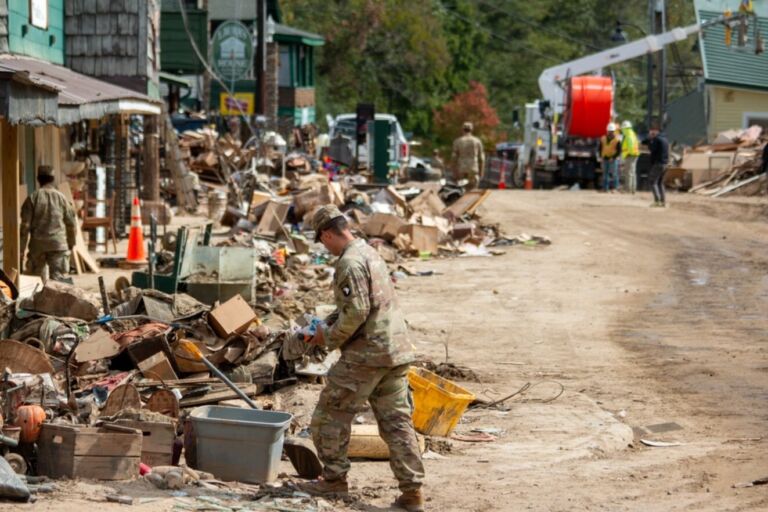
Leaders guiding long-term recovery efforts for western North Carolina after Hurricane Helene are exploring a sweeping strategy to attract private investment, rebuild infrastructure, and strengthen the region’s workforce pipeline as communities continue to recover from storm damage and economic disruption.
Members of theGovernor’s Recovery Office for Western NC (GROW NC) long-term economic recovery subcommittee discussed those strategies during a March 9 hour-long virtual meeting that focused on economic data, workforce development, and federal policy tools that could accelerate rebuilding across the region.
The full advisory committee met on March 6 in Marion and virtually for over two hours.
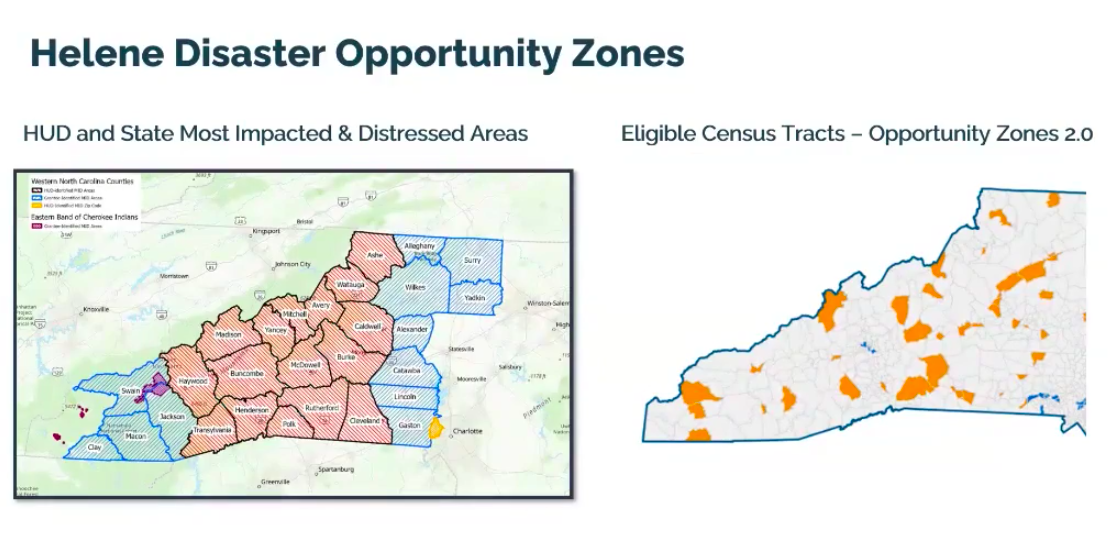
Among the most significant proposals under consideration is pursuing a federal “disaster opportunity zone” designation covering counties hardest hit by the storm — a move that advocates say could unlock long-term private investment in communities still struggling to rebuild.
Disaster investment zones under consideration
Subcommittee members said the designation could mirror programs previously used after other major disasters.
Under current federal rules, states can designate certain low-income census tracts as opportunity zones, allowing investors to receive tax benefits for investing in businesses or real estate projects in those areas.
But committee leaders said the existing map of potential zones in western North Carolina does not adequately capture the scope of Helene’s damage.
“The program as it exists now doesn’t do quite enough,” Sharon Decker, senior advisor to the GROW NC, told the group, noting that several distressed mountain counties would receive little or no coverage under the standard criteria.
The proposal being discussed would instead designate the region’s most impacted counties broadly as “disaster opportunity zones,” allowing for greater flexibility in attracting capital for rebuilding projects.
Members emphasized that private investment will be essential for recovery over the next decade.
“All of us agree that we’ve got to get more private investment into western North Carolina… over the next one to 10 years,” Decker said.
If adopted, the strategy would complement existing federal disaster programs and philanthropic contributions already flowing into the region.
Philanthropic and federal funding already underway
During the meeting, committee members also reviewed updates from recent briefings on recovery funding.
Officials noted that more than $1.4 billion in philanthropic aid has already been committed to the broader recovery effort, with multiple foundations coordinating to avoid duplication and maximize impact.
Federal funding tied to water and sewer infrastructure is also beginning to move, though local leaders say more will likely be needed.
According to briefing materials discussed during the meeting, about $685 million has already been appropriated for State Revolving Fund projects tied to Helene recovery.
Local governments have submitted more than 100 applications for assistance, highlighting the scale of infrastructure damage and the demand for rebuilding resources.
Committee members also discussed financing challenges for municipalities rebuilding water systems. Some communities are hesitant to accept short-term repayment schedules, even with zero-interest loans, because of strained local budgets following the storm.
Tourism recovery remains uneven
Economic data presented to the panel showed recovery is still uneven, particularly in tourism-dependent areas.
Employment across the region remains slightly below pre-storm levels, according to analysis presented to the subcommittee.
The hospitality sector — one of the mountain region’s largest employers — continues to lag.
In the Asheville metropolitan area, hospitality employment was still about 7% below pre-storm levels a year after Helene, improving slightly but remaining nearly 6% below the baseline several months later.
Those figures highlight the ongoing challenges facing tourism-driven communities as businesses rebuild and visitor traffic gradually returns.
“The rest of the economy is doing okay,” Dan Gerlach, consultant for Tapestry Collective, said, “but this sector is really a drag.”
Manufacturing employment in parts of western North Carolina has also softened, particularly in areas where factory jobs dominate the local economy.
Workforce development central to the recovery plan
Leaders are working with the region’s community colleges and philanthropic partners to launch a workforce initiative known as “Good Jobs Western North Carolina.”
The effort aims to create roughly 1,200 additional jobs in high-demand sectors, including health care, manufacturing, and skilled trades.
Officials say the program will focus on identifying workforce gaps, aligning training programs with employer needs, and improving connections between education systems and local industries.
The initiative is supported by the John M. Belk Endowment and the Leon Levine Foundation, which are helping fund early research and planning, officials said.
The project also seeks to better connect employers with community college training programs and identify where additional workforce investments are needed.
One early finding from the workforce analysis suggests that some labor shortages are not simply due to retirements. Instead, turnover among early-career workers is creating significant gaps in industries like health care, due in part to lower pay.
Community colleges seen as key asset
Participants highlighted the region’s extensive network of community colleges as one of its strongest recovery assets.
Programs across the colleges cover a wide range of workforce fields, from manufacturing and engineering technology to health care and emergency services.
Committee members said mapping those programs across all western North Carolina colleges is helping identify where training resources already exist — and where gaps remain.
The analysis could eventually help guide regional coordination among colleges and employers.
Next phase: building a regional recovery strategy
The GROW NC panel is expected to develop a draft long-term recovery framework this year.
That strategy will outline economic priorities, workforce goals, and policy recommendations designed to accelerate recovery from Hurricane Helene while strengthening the region’s long-term economic resilience.
Committee members also said they will begin recruiting volunteers from within the group to lead work on specific policy areas, including workforce development, small-business support, infrastructure investment, and tourism recovery.
Leaders hope the plan will be ready for review by early summer.
“We’re trying to accelerate what we’re doing,” said Laura Leatherwood, subcommittee co-chair and president of Blue Ridge Community College. “The goal is identifying the gaps and addressing them so we can move people through the pipeline and into these sectors faster.”
As western North Carolina continues rebuilding, the panel’s work could shape the economic roadmap for the region’s recovery over the next decade.
“GROW NC panel weighs disaster investment zones” was originally published on www.carolinajournal.com.

![[WBT107.9FM] app promo graphics 2025](https://wbt.com/wp-content/uploads/sites/84/2025/12/17653898024341.jpg?quality=80&strip=all&w=150&crop=0,0,100,150px)
