Top NC court seeks updates on open cases tied to Riggs-Griffin dispute
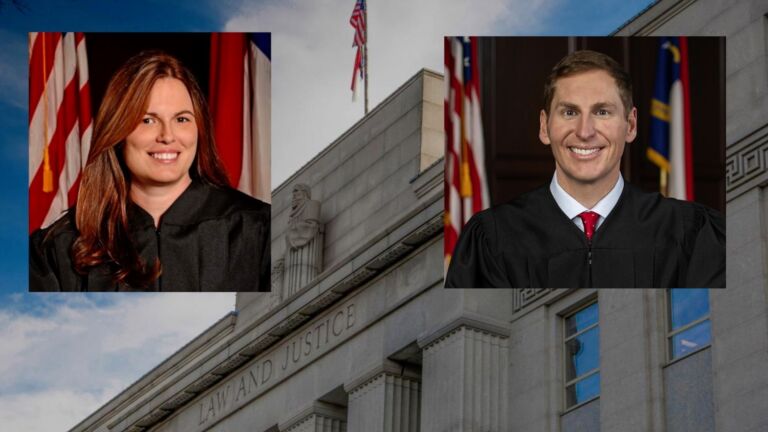
The North Carolina Supreme Court issued new orders Friday in two cases linked to the monthslong election dispute between high court candidates Allison Riggs and Jefferson Griffin in 2024 and 2025.
The orders ask Republican plaintiffs whether they still seek any relief from the state Supreme Court.
Riggs, a Democrat and an appointed incumbent, had to wait until May 2025 to be certified as the winner of the November 2024 state Supreme Court election. She defeated Griffin, a Republican state Appeals Court judge, by 734 votes out of more than 5.5 million ballots cast.
Griffin challenged the results in state and federal court. He questioned more than 65,000 ballots cast statewide. Most were cast by voters with registration records that appeared to lack federally required driver’s license or Social Security numbers. Griffin’s challenges also focused on overseas voters who provided no photo identification and “never residents,” voters who checked a box on a voter form indicating they had never lived in North Carolina.
The State Board of Elections certified Riggs as the winner after US Chief District Judge Richard Myers issued a May 5, 2025, order ending the election dispute. Myers rejected a state Supreme Court decision in April 2025 that placed at least 1,675 and as many as 5,700 ballots from the 2024 election in question.
Eight months later, two related cases called Kivett v. North Carolina State Board of Elections remain active with the state Supreme Court. Filed by the state and national Republican Party organizations, the cases focus on the incomplete voter registration records and “never residents” Griffin had targeted.
“The parties are directed to submit supplemental filings to the Court no later than 30 days from the date of this order addressing what relief, if any, plaintiffs are still pursuing from this Court and whether the relief sought is now moot or otherwise not justiciable,” the Supreme Court wrote Friday in identical orders for both cases.
No justice signed the orders. Riggs was recused in both cases.
In one of the Kivett cases, Republican Party lawyers first turned to the state Supreme Court days before the November 2024 election.
“Plaintiffs seek a simple but necessary solution to remedy an ongoing and increasingly dangerous threat to the integrity of North Carolina’s elections,” they wrote. “Evidence in the record makes clear that Defendants are allowing, in their own words, an ‘unknown’ number of overseas citizens who have never resided in North Carolina to register and vote in the state’s elections. This is an unabashed violation of Article VI § 2 of the state Constitution. Thus, Plaintiffs seek an order enjoining Defendants from counting these potentially illegal ballots and instead segregating and counting them as provisional ballots until the voter’s qualifications under all applicable and constitutional state and federal laws can be adequately established.”
In the other Kivett case, GOP lawyers challenged the state elections board’s voter registration practices.
“For over a decade the NCSBE employed a voter registration form which failed to collect the applicant’s driver’s license number or their social security number,” according to a February 2025 Supreme Court petition. “The NCSBE recognized this failure when it changed the statewide registration form on a forward-looking basis. However, the NCSBE repeatedly refused to contact any of the individuals who returned statutorily deficient registration forms. As a result, approximately 225,000 people are erroneously deemed ‘registered’ to vote in the state, despite each one failing to provide the driver’s license or a social security number required by law.”
Republican groups filed both Kivett cases while Democrats held a 3-2 majority on the State Board of Elections. Senate Bill 382, approved after the 2024 election, transferred election board appointments from the governor to the state auditor. Then-Gov. Roy Cooper and his successor, Gov. Josh Stein, are Democrats. Auditor Dave Boliek is a Republican.
Boliek used his appointments in 2025 to flip the elections board’s majority to 3-2 in the GOP’s favor. The North Carolina Appeals Court is scheduled to hear oral arguments on Feb. 10 in Stein’s lawsuit challenging the appointment shift.
The US Justice Department sued the elections board last spring over the issue of incomplete voter registration records. Justice Department lawyers and the Republican-led state elections board reached a settlement of that suit last September. The board’s ongoing Registration Repair Project is designed to fill in gaps in voters’ registration information.
Myers issued an order earlier this month rejecting requests from Democrats and left-of-center activists to revisit the settlement.
“Top NC court seeks updates on open cases tied to Riggs-Griffin dispute” was originally published on www.carolinajournal.com.


![[WBT107.9FM] app promo graphics 2025](https://wbt.com/wp-content/uploads/sites/84/2025/12/17653898024341.jpg?quality=80&strip=all&w=150&crop=0,0,100,150px)
