Appeals Court will not review Cumberland suit against DuPont, Chemours
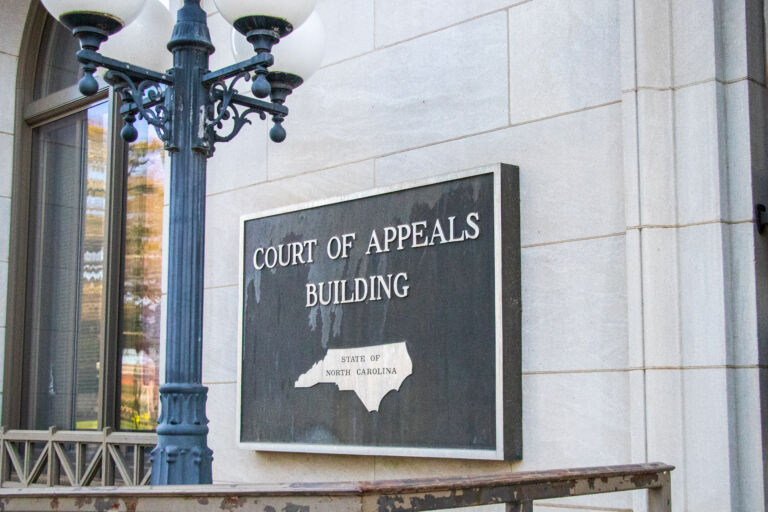
The North Carolina Court of Appeals has rejected DuPont and Chemours’ request to review a public nuisance lawsuit Cumberland County filed against the companies. The suit stemmed from PFAS releases at Chemours’ Fayetteville Works plant.
An unnamed three-judge Appeals Court panel agreed unanimously Thursday to deny Chemours’ petition for a review of the county’s complaint. The court’s order offered no explanation for the decision.
Cumberland County’s lawsuit is separate from legal action pitting state government against Chemours. The North Carolina Supreme Court issued a stay last October placing that case on hold.
“Defendants secretly used Cumberland County as a dumping ground to dispose of their toxic chemicals while assuring the public they were doing no such thing,” the county’s lawyers wrote in a Jan. 5 Appeals Court filing. “There is no dispute that Defendants released millions of pounds of toxic per- and polyfluoroalkyl chemicals (PFAS) into the air above their Fayetteville Works plant for nearly forty years. The wind spread Defendants’ toxic PFAS into Cumberland County, where it fell to the ground and contaminated the groundwater that thousands of Cumberland County residents rely on for their drinking water.”
“After years of discovery, the trial court granted partial summary judgment that Defendants were liable for causing a public nuisance and for trespass, reserving the damage and abatement remedy issues for the August 24, 2026, jury trial that Defendants stipulated to just weeks ago,” the January court filing continued.
Cumberland County labeled DuPont and Chemours’ petition “improper.”
“Defendants fail to show the extraordinary circumstances required to justify breaking the rule against piecemeal appeals,” the county’s lawyers wrote. “They seek intervention nearly four years into this case after discovery closed, after liability was resolved on two claims, after they stipulated to trial, and after delaying months to file this petition. Writ review would not resolve all pending claims or eliminate the need for trial. It would only delay it.”
The county acted within its power “to abate and remedy the public health nuisance Defendants caused,” according to the court filing. “Defendants’ rewriting of these statutes to limit county police powers to addressing only ‘structures’ or stopping the ‘cause’ of a public health nuisance contradicts these statutes’ clear language, violates the mandatory rule requiring broad interpretation of county authority under section 153A-4, and finds no support in North Carolina law.”
“Defendants created a public health nuisance by contaminating the communities’ source of drinking water,” Cumberland County argued. “Providing a clean source of water eliminates that threat and abates the public nuisance. Defendants downplay the threat to public health and disagree that abatement is necessary, but that disagreement raises contested issues of fact and expert testimony that the trial court set for trial starting in August 2026.”
DuPont and Chemours had filed a Dec. 15 petition for the Appeals Court to review the case.
“The County does not bring this action on behalf of the State of North Carolina or the North Carolina Department of Environmental Quality (ìNCDEQî), both of which have already separately sued over PFAS discharges from Fayetteville Works, but rather on behalf of the County generally,” the companies’ lawyers wrote.
“Through this lawsuit, the County acts as a second environmental regulator answering only to itself, free from the legislative or administrative rulemaking process,” DuPont and Chemours argued. “Relying primarily on a statute that allows counties to abate public nuisances, the County seeks to recover substantial money damages based on the supposed need to form and construct public water systems for Cumberland County residents, even though Chemours is already implementing a drinking-water program in the county in cooperation with a comprehensive Consent Order it entered into in litigation brought by NCDEQ concerning PFAS discharges from Fayetteville Works.”
“The County says that Section 153A-140 authorizes it to seek money damages to fund expansion of its public water systems to ‘abate’ the alleged public nuisance created by Fayetteville Works,” the companies’ lawyers wrote. “DuPont and Chemours, in their opposition to the County’s partial motion for summary judgment on public-nuisance liability, argued that Section 153A-140 does not permit a County to establish new water districts under the guise of ‘abating a nuisance.’”
Superior Court Judge Michael O’Foghludha “erred” when he agreed with the county in September 2025, Chemours argued. “The case law and legislative history of Section 153A-140 demonstrate that the statute permits only the abatement of the source of the nuisance; it does not empower the County to establish new water districts without regard to any abatement measures at the source of the alleged nuisance.”
Allowing Cumberland County to seek “its own remedy ignores the remedies already blessed by NCDEQ, the regulatory agency charged with environmental protection,” DuPont and Chemours’ lawyers wrote. “NCDEQ and Chemours have entered into a Consent Order requiring Chemours to test for and provide water-quality measures to those potentially impacted by PFAS emitted by Fayetteville Works. Further, the General Assembly has enacted a statute describing if and when people in the State are entitled to replacement water supplies, including connections to public water, and NCDEQ is charged with enforcing that statute.”
“Appeals Court will not review Cumberland suit against DuPont, Chemours” was originally published on www.carolinajournal.com.

![[WBT107.9FM] app promo graphics 2025](https://wbt.com/wp-content/uploads/sites/84/2025/12/17653898024341.jpg?quality=80&strip=all&w=150&crop=0,0,100,150px)

